The definition of the model consists of Api name, model name and field (including nested fields)
name(s) separated by dot “.”: {ApiName}.{ObjName}.{Field}, e.g: ErplyApi.Customer.FullName or
ErplyApi.Customer.Address.City, where ErplyApi is name of the API, Customer - name of the
model and rest is the field or if this is struct, then with nested fields.
If definition used as template data (wrapped into {{}}), then it should have prefix .Data,
e.g. {{ .Data.ErplyApi.Customer.FullName }}
If definition used in the form input names, then omit .Data prefix,
e.g. <input name="ErplyApi.Customer.FullName">
Each model name should have specific suffix which describes the scope where it is used:
Query (e.g. CustomerQuery) represents query model, usually used in search forms and submitted
as a GET request
Input(optional) (e.g. CustomerInput) represents the input model, mostly used in forms during
create or update actions. It is optional, an entity considered as an input object if there is no
suffix specified. Input models can be used in form input names and optionally in values as data
sets. One API entity may have multiple Input models.
Dto (e.g. CustomerDto) represents a data transfer object, usually it consists of one or many
entities from different APIs. May be used in previews or tables.
List (e.g. CurrencyList) represents the list of simple entities, usually used for populating
dropdowns.
Goerp has some built-in service variables, which can be used to pass some processing settings or to
get some service variables, such as session key, client code, etc.
Dynamic api gives an alternative way to handle the data. As opposed to the older model based handling.
For benefits this functionality relies on the api’s business logic entirely and does not need adjustments to models once
the api’s change.
It also allows to create as many request as you want against the same api and implements various
data manipulation helper functions.
Requests are defined by either input parameters from the browser (query or post) or by
static preset values. Preset values are values that are saved to the template during its
save time and this means that changing values cannot be used with them.
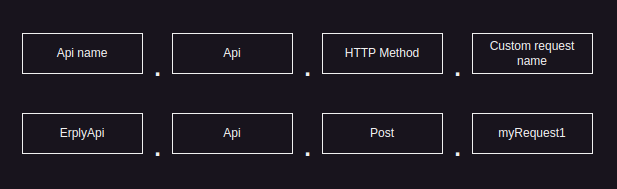
The syntax of the requests is the following
Api name Name of the api in question, reference the dynamic data source docs in the editor
for the full list of options.
Api Always has the value of Api, this tells the system that we intend to use the dynamic
api functionalities.
HTTP Method The http method that is to be used for the api call.
Get
Post
Put
Patch
Delete
FTPGet
FTPPut
Custom request name Custom name for the request you define, we use it later to set parameters
and read the results.
Requests naming
Request names are case-sensitive. Prefer giving self-explanatory names to the requests, so they will not
confuse while developing huge template with many requests. For example, if request made for v1/products
and used method Get, then name it getProducts, but not something like request1, records, etc.
Also, GoErp have reserved names that cannot be used while defining the name for request.
Reserved names:
Session (with Capital S, session is ok to use)
Parameters (with Capital P)
Storage (with Capital S)
Using in a form
The definition of the name is given to the form input name and the endpoint to call from that api is given
as the value.
Note that the value should not start with the character /.
The call is made when the page is accessed only when the parameter is actually passed. In the sample above
the parameter is registered in the form but is never actually sent as a parameter to the server.
In order to load the data we would need to submit the form.
The method of the form would define how the parameter is passed to the server either via query parameter
or a post parameter.
We can also load parameter into links to make the api to be called right away (before the page is enriched with data):
?ReportsApi.Api.Get.someReportsCall=v1/POSDay
This link would load the data when it is opened.
Defining static presets
When opening a page via url that has no query parameters then even if we have defined some api call into form
they would not be triggered.
Regular form values are not read from the template content, rather it is just written there to make the actual calls
by the browser.
There is a way however to set defaults to parameters, these values are saved during template save time
and are static values. This means that dynamic values that change in the template view process cannot be
passed onto them, the values that are added to it are the exact values that will be used for the request.
This allows the request to be made with some default values and to make it load something when a page
is opened without any parameters.
For this we can use the data-preset-val attribute on the inputs
Note that these do not need to be in the form as we might never send the parameter if we never
intend to send the form. In this case a single hidden input that is not part of a form is enough.
If the browser passes a parameter to the same value it will overwrite the preset value.
Url configuration static presets
From version 1.179.1 we can also set static preset values in the editor under the “URL configuration” menu.
These name:value pairs work the same way as regular preset value definitions, but when defined here the values
do not need to be in the template body at all.
Useful for pages that generate content that might not want to view the input but automatic loading of content
is required.
Request parameters
Defining request parameters
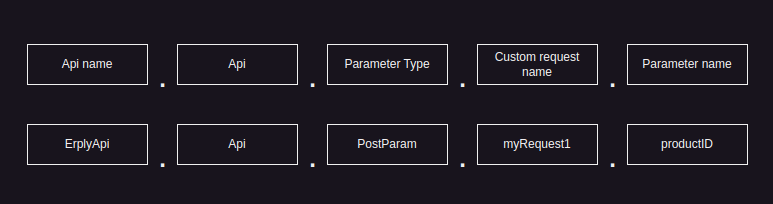
To pass parameters to the api we will use similar syntax like the one we use to define the requests.
The custom request name here should match exactly the one we used to define the request.
In the following example we add the query parameter currencyId for the request we defined as myReportsCall
Similar to the way we can give default values to requests we can also give default values to parameters.
Note that the values here are static meaning that we cannot add placeholders to the data-preset-val attribute.
The value is being saved on template save time and will not change during the page view process.
<formmethod="get"><inputtype="hidden"name="ReportsApi.Api.Get.myReportsCall"value="v1/POSDay"data-preset-val="v1/POSDay"><!-- We make the page load with currency ID 1, however we still allow it to be overwritten by the parameter --><labelfor="currencyId">Currency ID</label><inputid="currencyId"type="number"name="ReportsApi.Api.Query.myReportsCall.currencyId"data-preset-val="1"><buttontype="submit">Fetch</button></form>
If the browser passes a parameter to the same value it will overwrite the preset value.
Parameter types
Parameters are passed either via query or as post parameters. Samples here are generated into
form inputs, but they can as well be used in url query parameters (name=value).
This means the input will keep its value after the possible form submit and page reload
QueryBulk
Allows to pass as many query parameters as needed using one input. Parameter name here doesn’t matter
actually as it would be ignored anyway, but we can always name it url just to make it clear to read
If the api expects one of the parameters to be a path parameter we would define the request with
a placeholder and follow it up with a value for this placeholder.
Json inputs can be composed in a couple of different ways.
Input construction
With this method we will construct json with multiple input fields.
We also need to define the type of the field for the json constructor. Type is given just
before the parameter name. In many cases parameter name may represent the xpath in json, like
string.inner.name will result in {"inner":{"name":""}}
Omitting key definition after the dot will result in setting input value as a root object to the
json body.
Supported values
string - result: ({"name":"foo"})
number - result: ({"name":123})
boolean - result: ({"name":true})
json - result: ({"name":{"foo":"bar"}}). Allows to set any json structure.
delete - (special case to delete entire path from the json, value of the input would be ignored because only path is needed)
Starting from version 1.201.1, GoErp allows to make json modifications more flexible, like
predefined json, connecting json parts from another request and many more. Check how it works
with CAFA sample.
Raw
To send some custom data to the api endpoint that does not use a specific format (json, post params etc).
Note that the key name here is not important (myCustomData) and it will not be used in the request.
Usable for franchise accounts. Where the HQ account can make calls against certain stores. Note that the user
on the HQ account needs to have access to the specified store through the multi account users feature.
Using the value here will run the api call against that specific franchise account store.
Cache
Can be used to speed up page loads by caching certain api calls that do not use any parameters and are used mostly to
fill selections. Items will be stored against the session and will refresh automatically within 1 hour (this can be altered
with the duration parameter).
Define the cache key with a value of 1 to use the cache features. Adjusting the value to 0 or removing the key will disable
the feature.
Optionally you can set a different duration for the cached elements (in seconds).
This works together with the cache parameter and needs to exist when the data element is created.
If this value is not provided then the data will be cached by default for 3600 seconds.
The dynamic functionality returns the entire api response json content back as special
json object that we can manipulate with special commands to get back data.
Specifying the request to get the data for
If we had for example previously defined a request like this
The json values by default have special type that is always converted to a string when used in the template.
This means that if the intention is to use these values in some inbuilt helper function that expects a certain type
and the expected types are not what is expected then the function can break the template entirely.
To prevent this we can cast the values to the correct type in the functions.
{{ if eq (.Data.PricingApi.Api.Requests.myCall.Response.Get "age").Int }} 37 }}
<!-- Do something -->{{ end }}
These are special functions that can be used against the dynamic api json response content, to do special
conversions or other special functions with them.
Note that the following functions can also be used on the same result, for example we want to flatten and get unique values
at the same time.
It’s possible to chain different api fetches together. This is useful when a second api call would depend on the
results of the first.
Warning
By default, all subsequent requests will be skipped if parent one fails. Although, it is possible
to configure this behavior by making link optional. More details
Available chaining options
NB! Chaining options supported through value AND through data-preset-val parameters
Every request input parameters may be chained with other request and with data from GoErp in-build data sets.
In-build data sets:
Session (check structure of the Session by printing it out {{ toJson .Session }})
We can use the grouping definition to set the order of calls.
The pipe | at the end indicates grouping and the number says the order.
Multiple requests can have the same group number, this means they would be done at
the same time, and they do not depend on each other.
It is recommended to make as few requests as possible. This means that creating requests in first api response
loops is not recommended as it would take a large performance hit.
Instead, we can use special helper functions to collect the id’s and make a separate calls.
|@commaSepStr converts all the id’s of the get products response to comma separated string input for the pricing api.
Then we assign this value to productId parameter using the <- sign.
The value syntax here is similar to how the Get function works, so we can also assign single values when needed.
<!-- Add the id value of the first result --><inputtype="hidden"name="PricingApi.Api.Query.getPrices.<-productIDs"value="getProducts.Response.0.id">
Make chained link optional
Dynamics provides option to make link optional, which means, if parent request fails or there is no
data in chained location then request would be still executed but with empty parameter (from version 1.262.1: query, path and headers parameters will be skipped instead of empty values).To make link
optional just put ? after the link operator <-, like this <-?:
Dynamics provides option to skip the chain when parent has a value. That option could be useful
when we need to create a new record only if the parent request has no data. To skip the chain,
put ! after the link operator <-, like this <-!:
<!-- getPrices would be not executed if getProducts.Response.0.id has id in there --><inputtype="hidden"name="PricingApi.Api.Query.getPrices.<-!productIDs"value="getProducts.Response.0.id">
Define multiple sources for chaining
Sometimes we need to get first non-empty value from multiple sources. This can be done by using the
|| operator between sources. This will take the first non-empty value from the provided set of
sources. If all sources are empty and chain not optional, then request will be not executed. Works
with presets as well.
We can use the json query mechanism to get items from other api responses, or we can use the old-fashioned
id matching.
Query features
Using the inbuilt query features to return exact values. This can be useful when dealing with more complex
pages that try to compose multiple requests.
<ul>{{ range .Data.PIMApi.Api.Requests.getProducts.Response.Array }}
<!-- As values returned by the _Get_ function do not have a specific type we need to cast it into one --> {{ $productId := (.Get "id").Int }}
<li> Product code: {{ .Get "code" }}<br><!-- Get the price_with_tax value from the prices array by matching the productID there with current iteration id --> Price: {{ .Data.PricingApi.Api.Requests.getPrices.Response.Get (printf `#(productID==%d).price_with_tax` $productId) }}
</li>{{ end }}
</ul>
Id matching
Iterating through the second set is also an option. For something smaller this will probably be enough.
<ul>{{ range $product := .Data.PIMApi.Api.Requests.getProducts.Response.Array }}
<li> Product code: {{ $product.Get "code" }}<br> {{ range $price := $.Data.PricingApi.Api.Requests.getPrices.Response.Array }}
<!-- Still need to cast to the appropriate types --> {{ if eq ($price.Get "productID").Int ($product.Get "id").Int }}
<!-- Get the price_with_tax value if the id matches --> Price: {{ $price.Get "price_with_tax" }}
{{ end }}
{{ end }}
</li>{{ end }}
</ul>
Sample
In here we fetch a list of products and generate a list of images for them.
<divclass="my-error-container"> {{ range .Data.Errors }}
<spanclass="my-error-message">{{ . }}</span> {{ end }}
</div><inputtype="hidden"name="PIMApi.Api.Get.getProducts"data-preset-val="v1/product"><inputtype="hidden"name="PricingApi.Api.Get.getPrices|1"data-preset-val="v1/products/price-tax-rate"><inputtype="hidden"name="PricingApi.Api.Query.getPrices.warehouseID"data-preset-val="1"><inputtype="hidden"name="PricingApi.Api.Query.getPrices.<-productIDs"data-preset-val="getProducts.Response.#.id|@commaSepStr"><ul> {{ range .Data.PIMApi.Api.Requests.getProducts.Response.Array }}
<!-- As values returned by the _Get_ function do not have a specific type we need to cast it into one --> {{ $productId := (.Get "id").Int }}
<li> Product code: {{ .Get "code" }}<br><!-- Get the price_with_tax value from the prices array by matching the productID there with current iteration id --> Price: {{ $.Data.PricingApi.Api.Requests.getPrices.Response.Get (printf `#(productID==%d).price_with_tax` $productId) }}
</li> {{ end }}
</ul>
A more complex sample
This is a more complex sample that uses multiple api calls to save a new customer and various other
elements related to the customer.
Errors: {{ .Data.Errors }}<br/><h1>Customer input with address and fetching customer with all data in place</h1><formmethod="post"><!-- requests initialization --><inputtype="hidden"name="CRMApi.Api.Get.customerGroups"value="v1/customers/groups"data-preset-val="v1/customers/groups"><inputtype="hidden"name="CRMApi.Api.Post.createCustomer"value="v1/customers/individuals"><inputtype="hidden"name="CRMApi.Api.Post.createAddress|1"value="v1/addresses"><inputtype="hidden"name="CRMApi.Api.Get.customer|1"value="v1/customers"><inputtype="hidden"name="CRMApi.Api.Get.getAddress|2"value="v1/addresses"><inputtype="hidden"name="CRMApi.Api.Put.createAttribute|2"value="v1/attributes"><inputtype="hidden"name="CRMApi.Api.Delete.delAttribute|3"value="v1/attributes/{id}"><inputtype="hidden"name="CRMApi.Api.Get.getAddressTypes|3"value="v1/addresses/types"><inputtype="hidden"name="CRMApi.Api.Get.getBusinessAreas|3"value="v1/business/areas"><inputtype="hidden"name="CRMApi.Api.Get.getAttributes|4"value="v1/attributes"><!-- presets data --><inputtype="hidden"name="CRMApi.Api.Query.customerGroups.take"value=""data-preset-val="50"><!-- customer post, depth = 1 --><br/>First name:
<inputtype="text"name="CRMApi.Api.Json.createCustomer.string.firstName"value="{{ .Data.CRMApi.Api.Requests.customer.Json.Get "firstName"}}"><br/>Last name:
<inputtype="text"name="CRMApi.Api.Json.createCustomer.string.lastName"value="{{ .Data.CRMApi.Api.Requests.customer.Json.Get "lastName"}}"> {{ $gId := (.Data.CRMApi.Api.Requests.customer.Json.Get "customerGroupId").Int }}
<br/>Group: <selectname="CRMApi.Api.Json.createCustomer.number.customerGroupId"> {{ range $cg := .Data.CRMApi.Api.Requests.customerGroups.Response.Array }}
<optionvalue="{{ $cg.Get "id"}}"{{ifeq($cg.Get"id").Int$gId}}selected{{end}}> {{ $cg.Get "name.en" }}
</option> {{ end }}
</select><!-- address post, depth = 2 --><br/>Address street:
<inputtype="text"name="CRMApi.Api.Json.createAddress.string.street"value="{{ .Data.CRMApi.Api.Requests.createAddress.Json.Get "street"}}"><inputtype="hidden"name="CRMApi.Api.Json.createAddress.number.<-customerId"value="createCustomer.Response.id"><inputtype="hidden"name="CRMApi.Api.Json.createAddress.number.typeId"value="1"><!-- get created customer, depth = 2 --><inputtype="hidden"name="CRMApi.Api.Query.customer.<-ids"value="createCustomer.Response.id"><!-- get created address, depth = 3 --><inputtype="hidden"name="CRMApi.Api.Query.getAddress.<-customerIds"value="customer.Response.#.id|@commaSepStr"><br/>Attribute int:
<inputtype="number"name="CRMApi.Api.Json.createAttribute.number.value"value="int"><inputtype="hidden"name="CRMApi.Api.Json.createAttribute.string.entity"value="customer"><inputtype="hidden"name="CRMApi.Api.Json.createAttribute.string.name"value="test-dynamic-4"><inputtype="hidden"name="CRMApi.Api.Json.createAttribute.string.type"value="int"><inputtype="hidden"name="CRMApi.Api.Json.createAttribute.number.<-record_id"value="customer.Response.#.id|@commaSepStr"><!-- get created address, depth = 4 --><inputtype="hidden"name="CRMApi.Api.Path.delAttribute.<-id"value="createAttribute.Response.id"><inputtype="hidden"name="CRMApi.Api.Query.getAttributes.entityName"value="customer"><inputtype="hidden"name="CRMApi.Api.Query.getAttributes.<-recordIds"value="customer.Response.#.id|@commaSepStr"><br/><buttontype="submit">Submit</button></form><h1>Created customer</h1>{{ $cs := .Data.CRMApi.Api.Requests.customer.Response.Array }}
{{ if $cs }}
<br/>Response count: {{ len $cs }}
{{ $c := index $cs 0 }}
{{ $cId := ($c.Get "id").Int }}
<br/>ID: {{ $cId }}
<br/>First name: {{ $c.Get "firstName"}}
{{ $cgId := ($c.Get "customerGroupId").Int }}
<br/>Customer group: {{ .Data.CRMApi.Api.Requests.customerGroups.Response.Get (printf `#(id==%d).name.en` $cgId) }}
<br/>Addresses: {{ $.Data.CRMApi.Api.Requests.getAddress.Response.Get (printf `#(customerId==%d)#.street` $cId) }}
{{ end }}
<h1>Attributes</h1>{{ $attrs := .Data.CRMApi.Api.Requests.getAttributes.Response.Array }}
{{ if $attrs }}
{{ range $attrs }}
<br/>{{ .Get "name" }} | {{ .Get "type" }} | {{ .Get "value" }}
{{end}}
{{ end }}
A sample using chaining in reading images
A sample where we connect CDN images to product groups.
In here we can see that we can connect items that naturally do not have a connection in the database.
Before this sample 2 images have been created using the CDN api create image endpoint.
context: erply-product-group
productId: 0 for default and 3 for the existing one
<!-- Define request 1 for product groups --><inputtype="hidden"name="PIMApi.Api.Get.myProdGroups"value="v1/product/group"data-preset-val="v1/product/group"><!-- Chain images from CDN api, use results from first as input --><inputtype="hidden"name="CDNApi.Api.Get.myImages|1"value="images"data-preset-val="images"><inputtype="hidden"name="CDNApi.Api.Query.myImages.context"data-preset-val="erply-product-group"><inputtype="hidden"name="CDNApi.Api.Query.myImages.<-productId"data-preset-val="myProdGroups.Response.#.id|@commaSepStr"><p>Groups</p><ul> {{ range .Data.PIMApi.Api.Requests.myProdGroups.Response.Array }}
{{ $groupId := (.Get "id").Int }}
<li> {{ .Get "name.en" }} (ID: {{ $groupId }})
<!-- Fetch images for this group id using the dynamic query method --> {{ $images := $.Data.CDNApi.Api.Requests.myImages.Response.Get (printf `images.#(productId==%d)#.key` $groupId) }}
<ul> {{ if $images.Array }}
<!-- print matching items --> {{ range $images.Array }}
<li><imgsrc="{{ $.Session.Services.CDNApi.URL }}/images/{{ $.Session.ClientCode }}/{{ . }}?width=200&height=200"></li> {{ end }}
{{ else }}
<!-- Print default --><li><imgsrc="{{ $.Session.Services.CDNApi.URL }}/images/{{ $.Session.ClientCode }}/jJumxcXTSamiGhJgDGJ1kGFyQx4iqtksv4R3MnEsIc4APVqt2v.png?width=200&height=200"></li> {{ end }}
</ul></li> {{ end }}
</ul>
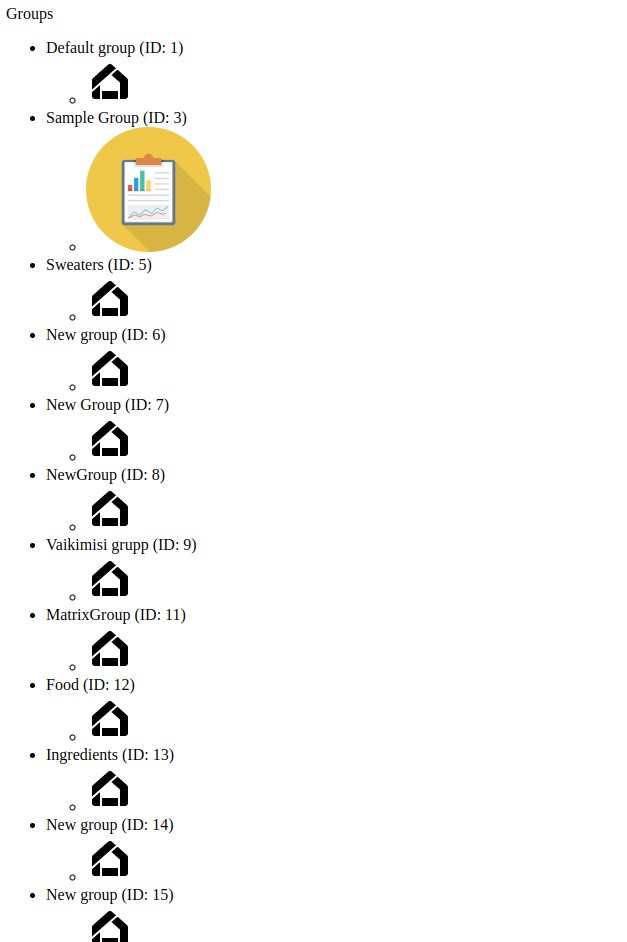
Result should look like this
Form redirect
Form redirect with dynamic api
Dynamic api uses a different kind of redirect from the models.
This redirect is only triggered if all the calls in the request succeed. If even one of them fails
(errors model in the response contains something) then by default redirection is not triggered.
However, there is a way to define optional requests that allowed to fail.
We define the redirection with Form.Redirect parameter
The syntax here is exactly the same as with responses, only difference is that instead of the usual {{ and }}
escapes we use [[ and ]] instead.
Use Form.AllowedToFailRequests input name to pass request names that allowed to fail and make redirect
to the desired page even if they failed. Request names should be separated by comma (,)
<!-- Assign the first id from the response to the redirect link --><inputtype="hidden"name="Form.Redirect"value="da-dynamic-redirect?someParameter=[[ .Data.PIMApi.Api.Requests.request1.Response.Get `0.id` ]]">
Sample
<formmethod="get"><!-- For 'request1' use your own custom identifier, use it to access the results --><inputtype="hidden"name="PIMApi.Api.Get.request1"value="/v1/product"><!-- Only redirects if all form containing requests succeed --><inputtype="hidden"name="Form.Redirect"value="da-dynamic-redirect?wat=[[ .Data.PIMApi.Api.Requests.request1.Response.Get `0.id` ]]"><inputtype="hidden"name="Form.AllowedToFailRequests"value="request1"><buttontype="submit">Redirect on success</button></form>
Input helpers
Helper functions for input
These are functions that help in generating input in a certain format that is difficult to create
using regular html inputs.
@doNotSkipOnEmpty
Allows to set a value to the input even if the value is empty.
@pimFilter & readPimFilter
Note
The regular pimFilter does not support ‘or’ operator between conditions and the operator always set to ‘and’. It also does
not support nested conditions. If the operator between conditions is needed or nesting of conditions then look for
the pimFilterV2 helper instead
PIM api filter structure is in json format and simple input by default cannot use it in a clean way. The following
functions help in generating the filters for it.
This is used at the end of the input name definition
Due to json filter structure and special characters in the instructions it’s not possible to read the value back
into the input fields using regular methods. For this we can use another helper function
Used to help generate pim filter json type structure from html inputs. Similar to the version 1 of the pimFilter
only that this one supports different operators between conditions and optionally also nesting of conditions.
Also since the ordering of the elements is important then the order helper should also be used when using the V2 variant.
Syntax for it is as follows:
Name of the field in pim
Operator: =, !=, >=, <=, in, not in, contains and startswith
Type of the value: string, number, bool
Optional. Add a nested group identifier, this is a random string value that group similar values to a nested group.
Note that in and not in operators expect the value to be a comma separated list of values.
Due to json filter structure and special characters in the instructions it’s not possible to read the value back
into the input fields using regular methods. For this we can use another helper function readPimFilterV2
Optionally we can also create nested filters with the group identifier parameter.
Do not forget to update the order of the functions and also the operator between possible groups.
In the sample we provide it a value of ‘a’, but the value is user defined. Everything with the value
will be nested in the same array.
Functions that related to the Json parameter type.
JSON field names may contain @ symbol, so function section definition starts with @{ and ends with }
to avoid collisions. E.g. @{order(1);foo(bar,rab)}. Functions separated by semicolon ;. Function
parameters separated by comma ,.
@order
Defines the order of inputs related to the json generation process.
In next sample initial structure of the json input would always be executed first and only then all
other inputs. This allows us to predefine the payload of json body and then change only necessary
fields.
(Optional) Adjust by date value (minute, hour, day, month or year)
(Optional) Integer (negative or positive) for the adjustment value
(Optional) Static value to suffix the formatted date on output
(Optional) Turn the static value to a prefix instead
Note it’s important to give the preset value of “default” for the function to insert the date value.
This is so that possible manual values will never be overwritten.
<!-- As suffix, without the 6th optional parameter --><inputtype="hidden"name="PIMApi.Api.Query.myRequest1.date@{setDefaultDate(UTC,2006-01-02,2006-01,day,0, 00:00:00)}"value=""data-preset-val="default"><!-- Would generate: 2024-08 00:00:00 --><!-- As prefix with the 6th parameter --><inputtype="hidden"name="PIMApi.Api.Query.myRequest1.date@{setDefaultDate(UTC,2006-01-02,2006-01,day,0,00:00:00 ,true)}"value=""data-preset-val="default"><!-- Would generate: 00:00:00 2024-08-->
It’s also possible to set the function to read the current accounts timezone configuration value instead.
To do this set the timezone value to from-conf.
Doing this the function will look for the value from accounts configuration:timezone value, if the value is not set
or has an invalid value then it defaults to UTC.
@formatDate
Used to alter the date format to formats that the possible api requires.
Mostly useful when the visual representation of the value in the UI is not the same as the api requires.
For example of the api needs unix but the UI should display regular year, month and day.
Parameters:
Timezone (use ‘from-conf’ to get the timezone value from accounts configuration)
(Optional) Adjust by date value (minute, hour, day, month, year, year, dtFirstDayOfWeek, dtLastDayOfWeek, dtFirstDayOfMonth, dtLastDayOfMonth, dtFirstDayOfYear or dtLastDayOfYear)
(Optional) Integer (negative or positive) for the adjustment value. for “dt” related types first applies adjustment then sets specific time. “dt” for weeks accepts only 0 or 1, which is bool for isSunday
(Optional) Static value to suffix the formatted date on output
(Optional) Turn the static value to a prefix instead
<!-- In this sample we take the value of 2024-04-25 and set it as unix timestamp when the api request is made --><inputtype="text"name="PIMApi.Api.Query.myRequest1.date@{formatDate(UTC,2006-01-02,unix)}"value="2024-04-25">
With the optional date adjustment parameters.
<!-- In this sample we take the value of 2024-04-25, append 5 days and set it as unix timestamp when the api request is made --><inputtype="text"name="PIMApi.Api.Query.myRequest1.date@{formatDate(UTC,2006-01-02,unix,day,5)}"value="2024-04-25">
Using the optional suffix and prefix.
<!-- As suffix, without the 7th optional parameter --><inputtype="hidden"name="PIMApi.Api.Query.myRequest1.date@{formatDate(UTC,2006-01-02,2006-01,day,0, 00:00:00)}"data-preset-val="2024-04-25"><!-- Would generate: 2024-08 00:00:00 --><!-- As prefix with the 7th parameter --><inputtype="hidden"name="PIMApi.Api.Query.myRequest1.date@{formatDate(UTC,2006-01-02,2006-01,day,0,00:00:00 ,true)}"data-preset-val="2024-04-25"><!-- Would generate: 00:00:00 2024-08-->
@encode
Version 1.222+
Can be used to encode the value. Supports base32, base64 and hex.
Default is base64 if parameter is omitted, provide the parameter to use a different encoding.
<!-- Defaults to base64 --><inputtype="text"name="ReportsApi.Api.Query.myRequest1.someData@{encode}"value="some value to be encoded"><!-- Request specific --><inputtype="text"name="ReportsApi.Api.Query.myRequest1.someData@{encode(base64)}"value="some value to be encoded"><!-- Hex example --><inputtype="text"name="ReportsApi.Api.Query.myRequest1.someData@{encode(hex)}"value="some value to be encoded">
@decode
Version 1.222+
Can be used to decode an encoded api response value to a string (supports base32, base64 and hex).
Default is base64 if parameter is omitted, provide the parameter to use a different encoding.
<!-- Defaults to base64 --><inputtype="text"name="ReportsApi.Api.Query.myRequest1.someData@{decode}"value="some value to be encoded"><!-- Request specific --><inputtype="text"name="ReportsApi.Api.Query.myRequest1.someData@{decode(base64)}"value="some value to be encoded"><!-- Hex example --><inputtype="text"name="ReportsApi.Api.Query.myRequest1.someData@{decode(hex)}"value="dGVzdA==">
@hash
Version 1.222+
Can be used to hash an api value according to an algorithm. Supports md5, sha1, sha256 and sha512.
Defaults to sha1 if the parameter is not provided.
<!-- Defaults to sha1 --><inputtype="text"name="ReportsApi.Api.Query.myRequest1.someData@{hash}"value="some value to be encoded"><!-- Request specific --><inputtype="text"name="ReportsApi.Api.Query.myRequest1.someData@{hash(sha1)}"value="some value to be encoded"><!-- md5 example --><inputtype="text"name="ReportsApi.Api.Query.myRequest1.someData@{hash(md5)}"value="value to be hashed">
@encrypt / @decrypt
Version 1.254+
This can be used to encrypt the data that is being saved in the api (kvs for example). This means that the data
will only be readable when the correct key is provided.
The feature uses AES cipher, and the protection strength is determined by the given key length.
Note that the keys need to use the correct length (16, 24 or 32)
16 characters : AES-128
24 characters : AES-192
32 characters : AES-256
Setting the keys to requests
Set the key for the request so the encryption knows what it needs to use.
<!--
Remember that ordering is important here as we need the system to always have the key before any encryption.
In this sample we use the chaining to take the key from the variables file, but the value can be taken from
any other api call or from a hardcoded value.
--><inputtype="hidden"name="KvsApi.Api.Encrypt.myRequest1.<-key@{order(1)}"value="Variables.someKey"data-preset-val="Variables.someKey">
Also note that if the save and read is done on the same page then the key should be added for both calls.
Encrypting the values
Once we have set the key then we can use the encrypt helper on the values we want to protect.
<!--
Use the order here to make sure that this is done after the key set.
Any api string value can be protected like this (limited to the max length of them).
--><inputtype="text"name="KvsApi.Api.Json.myRequest1.string.value@{order(2);encrypt}"value="some value to be encoded">
Decrypting
Remember to set the key for reading, otherwise the api will return an unreadable string.
<!-- When reading we also need to set the key --><inputtype="hidden"name="KvsApi.Api.Encrypt.myRequest2.<-key"value="Variables.someKey"data-preset-val="Variables.someKey">
Use the decrypt tools helper to read the data.
Note
The method will not inform you of an invalid or missing keys, instead it will generate random garbage values every single load.
<ul>{{ range .Data.KvsApi.Api.Requests.myRequest2.Response.Array }}
<li>{{ $.Tools.Decrypt (.Get "value").String }}</li>{{ end }}
<ul>
Sample
A simple save and read sample using kvs api.
<formmethod="post"><inputtype="hidden"name="KvsApi.Api.Post.myRequest1"value="api/v1/entry"><inputtype="hidden"name="KvsApi.Api.Encrypt.myRequest1.<-key@{order(1)}"value="Variables.someKey"data-preset-val="Variables.someKey"><inputtype="hidden"name="KvsApi.Api.Json.myRequest1.string.topicId"value="5afb02fc-04a5-4524-a816-4381f97b1few"><inputtype="hidden"name="KvsApi.Api.Json.myRequest1.string.key"value="my-value"><inputtype="text"name="KvsApi.Api.Json.myRequest1.string.value@{order(2);encrypt}"value="some value to be encoded"><buttontype="submit">send</button></form><inputtype="hidden"name="KvsApi.Api.Get.myRequest2|2"value="api/v1/entry"data-preset-val="api/v1/entry"><inputtype="hidden"name="KvsApi.Api.Encrypt.myRequest2.<-key"value="Variables.someKey"data-preset-val="Variables.someKey"><inputtype="hidden"name="KvsApi.Api.Query.myRequest2.topicId"value="1"data-preset-val="5afb02fc-04a5-4524-a816-4381f97b1few"><br><ul>{{ range .Data.KvsApi.Api.Requests.myRequest2.Response.Array }}
<li>{{ $.Tools.Decrypt (.Get "value").String }}</li>{{ end }}
<ul>
@toArrIndexParameters
Can be used to generate multiple request parameters based on input array from another dynamic result.
For use cases where the api expects indexed requests.
Basically wraps entire content into provided suffix and prefix. This function always accepts two
parameters, if there is more or less than two, then initial value is returned.
Starting from version 1.201.1, GoErp allows to make json modifications more flexible, like
predefined json, connecting json parts from another request and many more.
Let’s take CAFA as an example, as it will use most of the modification options.
<h1>Dynamic CAFA</h1><formmethod="post"><!-- Defining variables to get rid of very long value definitions in the inputs --> {{ $putConfBody := .Data.CaFaApi.Api.Requests.putConf.Json }}
{{ $getConfStateResp := .Data.CaFaApi.Api.Requests.getConfState.Response.Get "0" }}
<!-- 1. Load initial state of the configuration --><inputtype="hidden"name="CaFaApi.Api.Get.getConfState"value="configuration"data-preset-val="configuration"><!-- 2. provide query parameters for the configuration entry --><inputtype="hidden"name="CaFaApi.Api.QueryBulk.getConfState.url"value="application=my-app&level=Company&name=dynamic-sample"data-preset-val="application=my-app&level=Company&name=dynamic-sample"><!-- 3. Create save call with initial json payload --><inputtype="hidden"name="CaFaApi.Api.Put.putConf|1"value="v3/configuration"> {{ if $getConfStateResp.Exists }}
<inputtype="hidden"name="CaFaApi.Api.Json.putConf.json.<-@{order(1)}"value="getConfState.Response.0"> {{ else }}
<inputtype="hidden"name="CaFaApi.Api.Json.putConf.json.@{order(1)}"value='{"application":"my-app","level":"Company","name":"dynamic-sample","value":{}}'> {{ end }}
<!-- 4. Optionally, check updated state of the entry. --><inputtype="hidden"name="CaFaApi.Api.Get.getConfFinal|2"value="v3/configuration/{id}"><inputtype="hidden"name="CaFaApi.Api.Path.getConfFinal.<-id"value="putConf.Response.id"><!-- 5. Modify section, use same approach to as many fields as needed --><br/>Cat Murka age:
<inputtype="text"name="CaFaApi.Api.Json.putConf.number.value.pets.murka.age"value='{{ if $putConfBody.Exists }}{{ $putConfBody.Get "value.pets.murka.age" }}{{ else}}{{ $getConfStateResp.Get "value.pets.murka.age" }}{{ end }}'><buttontype="submit">Submit</button></form><h2>Before update</h2>Murka age: {{ .Data.CaFaApi.Api.Requests.getConfState.Response.Get "0.value.pets.murka.age" }}
<h2>After update</h2>Murka age: {{ .Data.CaFaApi.Api.Requests.getConfFinal.Response.Get "0.value.pets.murka.age" }}
Firstly, we need to have current state of the configuration, so we are loading it from the api
with getConfState request. Later we can use it for the “first page loading” event to display
current state.
Here, with QueryBulk parameter type we are preparing a bunch of static query parameters to get
specific configuration entry, based on application, level and name.
This part of the code allows as to prepare initial body of the json payload. We are getting the
payload from getConfState if it is available, or generating totally new one otherwise. Also,
we are using input functions
feature to define the order for json input parameters. By default, GoErp receives all parameters
in a chaotic order. But we need to be sure that initial structure assignment goes always first,
so we are defining order by setting it to 1. Additionally, we need to assign the payload to body
as a root object. To do that, just omit key definition after the dot (with key: .json.key, and
without: .json.).
Optionally, we are defining request getConfFinal to retrieve configuration updated state,
just to see that configuration was changed. In most cases it is not needed in real applications.
In this section we are making modifications to the configuration object and making sure that
UI displays correct value for each case: 1) first load of the page and 2) after update event.
We know, that if json body of the put request is available, then we came to this page right after
save, otherwise it is first loading. Variables were defined just to make input value look smaller.
The final working example with a couple more fields after removing all unnecessary stuff:
<!-- Vars section -->{{ $putConfBody := .Data.CaFaApi.Api.Requests.putConf.Json }}
{{ $getConfStateResp := .Data.CaFaApi.Api.Requests.getConfState.Response.Get "0" }}
<h1>Dynamic CAFA</h1><formmethod="post"><inputtype="hidden"name="CaFaApi.Api.Get.getConfState"value="configuration"data-preset-val="configuration"><inputtype="hidden"name="CaFaApi.Api.QueryBulk.getConfState.url"value="application=my-app&level=Company&name=dynamic-sample"data-preset-val="application=my-app&level=Company&name=dynamic-sample"><inputtype="hidden"name="CaFaApi.Api.Put.putConf|1"value="v3/configuration"> {{ if $getConfStateResp.Exists }}
<inputtype="hidden"name="CaFaApi.Api.Json.putConf.json.<-@{order(1)}"value="getConfState.Response.0"> {{ else }}
<inputtype="hidden"name="CaFaApi.Api.Json.putConf.json.@{order(1)}"value='{"application":"my-app","level":"Company","name":"dynamic-sample","value":{}}'> {{ end }}
<inputtype="hidden"name="CaFaApi.Api.Get.getConfFinal|2"value="v3/configuration/{id}"><inputtype="hidden"name="CaFaApi.Api.Path.getConfFinal.<-id"value="putConf.Response.id"><!-- Modify section --><br/>Cat Murka age: <inputtype="text"name="CaFaApi.Api.Json.putConf.number.value.pets.murka.age"value='{{ if $putConfBody.Exists }}{{ ($putConfBody.Get "value.pets.murka.age").String }}{{ else}}{{ ($getConfStateResp.Get "value.pets.murka.age").String }}{{ end }}'><br/>Cat Murka breed: <inputtype="text"name="CaFaApi.Api.Json.putConf.string.value.pets.murka.breed"value='{{ if $putConfBody.Exists }}{{ ($putConfBody.Get "value.pets.murka.breed").String }}{{ else}}{{ ($getConfStateResp.Get "value.pets.murka.breed").String }}{{ end }}'><br/>Cat Murka kind: <inputtype="text"name="CaFaApi.Api.Json.putConf.string.value.pets.murka.kind"value='{{ if $putConfBody.Exists }}{{ ($putConfBody.Get "value.pets.murka.kind").String }}{{ else}}{{ ($getConfStateResp.Get "value.pets.murka.kind").String }}{{ end }}'><br/><buttontype="submit">Submit </button></form>
Form drafts
It’s possible to instruct the form to keep certain dynamic api parameters for api requests but not trigger the corresponding
api request with the post until instructed to do so.
This can be used to make ‘drafts’ from inputs that will not trigger the api calls.
Hold all api request
The following form entry will prevent all dynamic api calls from triggering, but keeps all the parameters intact.
Note that this also affects api calls that are done by presets.
Server will not run any dynamic api calls when the value of the Form.HoldDraft is true. Inputs against these calls can be changed
and posted without the actual calls being initiated.
<formmethod="post"><inputtype="hidden"id="req"name="ErplyApi.Api.Post.myRequest1"value="getProducts"><labelfor="id">Records on page</label><inputtype="text"id="id"name="ErplyApi.Api.PostParam.myRequest1.recordsOnPage"value="{{ index .Data.Parameters "ErplyApi.Api.PostParam.myRequest1.recordsOnPage"}}"><labelfor="hold-state">Hold draft</label><inputtype="checkbox"id="hold-state"name="Form.HoldDraft"value="true"><buttontype="submit">send</button></form>
Hold specific api calls
In order the enrich data with additional possible api calls but hold others as drafts we can use a different input.
All dynamic requests that have the names will not be executed.
Can possibly make stepper type templates using this method.
In this sample the same ‘Send’ will run request1 and request2 in sequence.
<formmethod="post"><inputtype="hidden"id="req"name="ErplyApi.Api.Post.myRequest1"value="getProducts"><inputtype="hidden"id="req"name="ErplyApi.Api.Post.myRequest2"value="getProducts"><labelfor="id">Records on page</label><inputtype="text"id="id"name="ErplyApi.Api.PostParam.myRequest1.recordsOnPage"value="{{ index .Data.Parameters "ErplyApi.Api.PostParam.myRequest1.recordsOnPage"}}"><labelfor="id">Records 2 on page</label><inputtype="text"id="id"name="ErplyApi.Api.PostParam.myRequest2.recordsOnPage"value="{{ index .Data.Parameters "ErplyApi.Api.PostParam.myRequest2.recordsOnPage"}}"> {{ if ne .Data.ErplyApi.Api.Requests.myRequest1.Response.Exists true }}
<inputtype="text"id="hold-state"name="Form.HoldDraftFor"value="myRequest2"> {{ end }}
<buttontype="submit">send</button></form>
Making FTP requests
Since v1.277.0 GoErp supports FTP requests in dynamics. This feature allows to upload or
download files to/from servers through FTP protocol as well as a couple of additional actions like
moving files, getting directory list, etc.
Warning
Since v1.301.3FTPGet and FTPPut are deprecated and will be removed in future versions.
Instead, use FTP as a method while initializing the request and pass action name in cmd
through PostParam.
Input parameters
Initialization of the request is made through FTP method type. Like so:
<input type="hidden" name="CustomApi.Api.FTP.file" value="localhost:2121">. Value in this case
contains the FTP server host with port. Port is mandatory parameter. If provider not specified the
port, then the default ports for ftp 21,2121, and for ftps 990.
Actions request and response parameters
All requests expecting credentials and cmd to be passed through PostParam type:
cmd - FTP command (or action). All available commands are listed below.
schema - ftp or ftps. If not set, then GoErp will try to get it from the link and if fails then uses ftp.
username - FTP server username.
password - FTP server password.
get
Input parameters:
cmd - get
path - Path to the file on the server. Example: /path/to/file.txt.
Displaying the names of files and directories in the specified path (subdirectories not included). Every element in the list has detailed information about entry.
{"error":"550 Could not access file: open /tmp/my-data: no such file or directory","status":"error"}
Form control
Always used with forms. Goerp application handles all pages with one dynamic handler and pages may
have multiple forms. When the page is processed by the handler, then all forms and related input
models are involved. We need to know the exact model to be sure that after submitting the form POST
request, the right model gets processed. This model name should be passed with the postActionEntity
input name.
All form control fields:
postAction - what action should be applied to the entity, currently there is only one option -
delete, if passed then form control should also have postActionIds input included. If postAction
is not specified, then by default applied save/update action.
postActionIds - entity ID’s separated by comma (,). Those are input parameters for performing
changes under specific entities (in most cases deleting them)
postActionEntity - defines the model name which is related to the form. Needed only for the
save, update and delete options (not needed in query type forms). Supports multiple entities, each
of them should be defined in separate input with the same name, check Multi-entity form topic in
this section.
postActionRedirect - defines the link where to redirect after successful post action (not
applied to delete action and to forms with GET method)
Do not use any form control inputs while submitting the form using GET method (at least for now
there is no practical use of form control options in GET requests).
Use GET requests to fetch multiple data for tables using Query model, or to fetch
single Input entity (usually just passing its ID) while defining link to the edit form.
Query models always connected with the List models. When defining the List model in your
template,
GOERP will make request to the related API and fetch data based on the Query parameters.
<formmethod="get"id="query-form"><labelfor="query-parameter-1">Query parameter 1:</label><inputtype="text"id="query-parameter-1"name="Api.ModelQuery.Field"value="{{ .Data.Api.ModelQuery.Field }}"><labelfor="query-parameter-2">Query parameter 2:</label><inputtype="text"id="query-parameter-2"name="Api.ModelQuery.AnotherField"value="{{ .Data.Api.ModelQuery.AnotherField }}"><buttontype="submit">Find</button></form><!-- Use List entities to actually apply the query, otherwise Query parameters will be ignored --><ul> {{ range .Data.Api.ModelList }}
<li>{{ .Name }}</li> {{ end }}
</ul>
POST for create and update actions
Let’s take a look into simple create/update example form:
<formmethod="post"id="post-form"><!-- For saving action need to pass only postActionEntity, which will ensure that you are working with correct model --><inputtype="hidden"name="postActionEntity"value="ModelInput"><!-- Optionally, use redirect option to redirect to the specified page after successful saving --><inputtype="hidden"name="postActionRedirect"value="https://erply.com/"><!-- Next 2 fields are related to actual model parameters --><labelfor="input-1">Input 1:</label><inputtype="text"id="input-1"name="Api.ModelInput.Field"value="{{ .Data.Api.ModelInput.Field }}"><labelfor="input-2">Input 2:</label><inputtype="text"id="input-2"name="Api.ModelInput.AnotherField"value="{{ .Data.Api.ModelInput.AnotherField }}"><buttontype="submit"id="save">Save</button></form>
Often we need to make reference from the list of rows to the specific entity edit form. In this case
pass entity ID from the selected row to the edit link by attaching it to the Input ID (some input
models doesn’t have Input suffix, but you can check in data source definitions in editor if model
have “write” option):
<!-- Use built-in .Session object to access account related configuration --><!-- Use prefix '$' if linking made inside the range loop, otherwise omit it --><ahref="/{{ $.Session.ClientCode }}/{{ $.Session.Language.Code }}/example-page?Api.ModelInput.Id={{ .Id }}"target="_self"class="table-action-button"><iclass="button nowrap button--transparent icon-Edit-Line"></i></a>
POST for delete action
Delete actions should be made by following next steps:
Form must have method parameter set to POST
Inside the form set hidden postAction input to delete
Inside the form set hidden postActionIds input to entity IDs (separated by comma) that should be
deleted (using custom JS or predefined goerp components)
Inside the form set hidden postActionEntity input to the entity name that should be deleted. If
it is row in the table, then that entity should have suffix List (e.g. WarehouseDtoList
or WarehouseDtoList). If deleting from the single entity edit form, then suffix may be Input
or just model name, check data sources definition in the editor for exact model names. Please
note, postActionEntity value shouldn’t have API definition, just model name.
<formmethod="get"id="entity-table-id"><inputtype="hidden"name="postAction"value="delete"><inputtype="hidden"name="postActionIds"value=""><inputtype="hidden"name="postActionEntity"value="ModelList"><!-- Add submit button if delete modal not used --><!-- <button type="submit">DELETE</button>--></form><!-- and then somewhere in the list range --><ul> {{ range .Data.Api.ModelList }}
<li>{{ .Name }}</li><!-- If used delete-confirm-partial component, then define next parameters inside the button --><buttondata-form-id="entity-table-id"data-delete-identifier="{{ .Id }}"data-post-action-entity="ModelList"class="button button--transparent nowrap table-action-button action-row-red form-delete-button"><iclass="icon-Trash-Empty-NotFilled"></i></button> {{ end }}
</ul><!-- As an option, somewhere in the end of the page import delete-confirm-modal from goerp components and use it --><!-- to delete one or many entities. Or write your own deletion logic -->{{ template "delete-confirm-partial" .}}
Multi-entity form
GOERP now supports multiple entities definitions in one form, which allows to save data of many
different, unrelated entities at once.
Note
Multi-entity form supports only one postAction type for all scoped entities. For example, it cannot
be used to delete one and create another entity at once. Only delete for all related entities OR
create/update for all related entities.
Let’s say we need to create warehouse and point of sale records by submitting them in one form, then
code would look like this:
<formmethod="POST"> {{/* Define entity names that should be processed */}}
<inputtype="hidden"name="postActionEntity"value="WarehouseInput"><inputtype="hidden"name="postActionEntity"value="PointOfSale"> {{/* Warehouse input data */}}
<fieldset><legend>Warehouse:</legend><labelfor="name-eng">Name eng:</label><inputtype="text"id="name-eng"name="AccountAdminApi.WarehouseInput.Name.en"value="{{ .Data.AccountAdminApi.WarehouseInput.Name.en }}"><labelfor="name-est">Name est:</label><inputtype="text"id="name-est"name="AccountAdminApi.WarehouseInput.Name.et"value="{{ .Data.AccountAdminApi.WarehouseInput.Name.et }}"></fieldset> {{/* Point of sale input data */}}
<fieldset><legend>Point of sale:</legend><labelfor="name-pos">Name:</label><inputtype="text"id="name-pos"name="AccountAdminApi.PointOfSale.Name"value="{{ .Data.AccountAdminApi.PointOfSale.Name }}"><labelfor="name-shop">Shop name:</label><inputtype="text"id="name-shop"name="AccountAdminApi.PointOfSale.ShopName"value="{{ .Data.AccountAdminApi.PointOfSale.ShopName }}"></fieldset></form>
Bulk-entity form
Some input entities in GOERP may be submitted as a bulk (having multiple records in scope of one
form submit), allowing to create or update multiple records at once. Such inputs have array types in
data source definition - []string (e.g. ErplyApi.ProductInSupplierPriceList). Also, bulk
input fields may be a part of some complex input entities (e.g. ErplyApi.SalesDocumentInput)
accepts many Row’s as part of the input.
Warning
Every row in the bulk should always have same order of inputs as others (check samples).
All rows in the bulk should always have same amount of inputs. For example, goerp will fail
if one row contains Name and Code and second one have ID, Name and Code. If ID
undefined, then pass empty value with an input.
Bulk-entity form sample
<formmethod="POST"> {{/* Define entity name that should be processed */}}
<inputtype="hidden"name="postActionEntity"value="ProductInSupplierPriceList"> {{/* Empty row (to add new) */}}
<fieldset><legend>Create row:</legend><labelfor="spl-id">Supplier price list ID:</label><inputtype="text"id="spl-id"name="ErplyApi.ProductInSupplierPriceList.SupplierPriceListID"><labelfor="product-id">Product ID:</label><inputtype="text"id="product-id"name="ErplyApi.ProductInSupplierPriceList.ProductID"></fieldset><h2>Existing rows</h2> {{/* Populate existing rows for update */}}
{{ range $i, $el := .Data.ErplyApi.ProductInSupplierPriceListList }}
<fieldset><legend>Row {{$i}}:</legend><labelfor="spl-id-{{$i}}">Supplier price list ID:</label><inputtype="text"id="spl-id-{{$i}}"name="ErplyApi.ProductInSupplierPriceList.SupplierPriceListID"value="{{$el.SupplierPriceListID}}"><labelfor="product-id-{{$i}}">Product ID:</label><inputtype="text"id="product-id-{{$i}}"name="ErplyApi.ProductInSupplierPriceList.ProductID"value="{{$el.ProductID}}"></fieldset> {{ end }}
</form>
Subsections of Bulk-entity form
Sales document sample
<!-- Display possible api errors --><div> {{ range .Data.Errors }}
<span>{{ . }}</span> {{ end }}
</div><formmethod="post"><!-- Field used by goErp to state what we want to save --><inputtype="hidden"name="postActionEntity"value="SalesDocumentInput"/><!-- Need to set the ID of the existing document --><inputtype="hidden"name="ErplyApi.SalesDocumentInput.ID"value="{{ .Data.ErplyApi.SalesDocumentInput.ID }}"><table><thead><tr><th>Product ID</th><th>Amount</th><th>Price</th></tr></thead><tbody> {{ range $row := .Data.ErplyApi.SalesDocument.Rows }}
<tr><td><!-- Stable row id is used by erply api to determine existing rows
the api always replaces all rows so adding a single row means all rows need to be resaved --><inputtype="hidden"name="ErplyApi.SalesDocumentInput.RowStableRowID"value="{{ $row.StableRowID }}"><inputname="ErplyApi.SalesDocumentInput.RowProductID"value="{{ $row.ProductID }}"></td><td><inputname="ErplyApi.SalesDocumentInput.RowAmount"value="{{ $row.Amount }}"></td><td><inputname="ErplyApi.SalesDocumentInput.RowPrice"value="{{ $row.Price }}"></td></tr> {{ end }}
<tr><td><inputtype="hidden"name="ErplyApi.SalesDocumentInput.RowStableRowID"value="0"><inputname="ErplyApi.SalesDocumentInput.RowProductID"value=""placeholder="Product ID"></td><td><inputname="ErplyApi.SalesDocumentInput.RowAmount"value="0"></td><!-- Manual pricing allowed? --><td><inputname="ErplyApi.SalesDocumentInput.RowPrice"value="0"></td></tr></tbody></table><!-- Erply api returns this boolean as a string 0 or 1 for some reason --> {{ if eq .Data.ErplyApi.SalesDocument.Confirmed "1" }}
<h2>Confirmed documents cannot be edited</h2> {{ else }}
<buttontype="submit">Save</button> {{ end }}
</form>
Session
Contains service information, like session key, client code, etc…
Syntax: {{ .Session.ClientCode }} Full list of parameters:
.Session.ClientCode
.Session.SessionKey

.Session.User.ID
.Session.User.FullName
.Session.User.EmployeeID
.Session.User.EmployeeName
.Session.User.GroupID
.Session.User.BOLoginUrl // Back office url for current user

<!-- Services May be extended in feature -->
.Session.Services.ErplyApi.URL
.Session.Services.Auth.URL
.Session.Services.AccountAdmin.URL
.Session.Services.Assignments.URL
.Session.Services.CaFa.URL
.Session.Services.PointOfSaleApi.URL
.Session.Services.UserApi.URL
.Session.Services.WMSApi.URL
.Session.Services.CrmApi.URL
.Session.Services.PricingApi.URL
.Session.Services.PimApi.URL
.Session.Services.VinApi.URL
.Session.Services.InventoryTransactionApi.URL
.Session.Services.InventoryDocumentApi.URL
.Session.Services.IntLog.URL
.Session.Services.ReportsApi.URL
.Session.Services.WebhookManager.URL
.Session.Services.EMSApi.URL
.Session.Services.EInvoiceApi.URL
.Session.Services.KvsApi.URL

.Session.Language.Code
.Session.DefaultLanguage.Code

.Session.AccountConfiguration.configurations
Some notes about specific parameters:
.Session.AccountConfiguration.configurations contains all erply configuration parameters
.Session.Language.Code two letter code of the currently set account language
.Session.DefaultLanguage.Code two letter code of the default account language
Parameters
Not controlled by goerp, can be used to mirror some data after submitting the form. Basically, goerp
will return all assigned parameters data with the response.
Let’s say we want to pass some data to the next page, using regular query parameter:
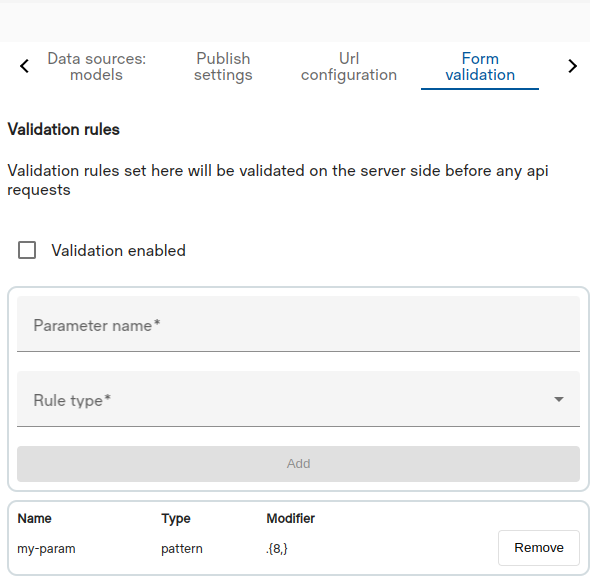
It’s possible to instruct the server to validate incoming parameters to certain rules.
Register the rules on page “Form validation” configuration section.
Enable and disable feature
You can use the toggle button to disable or enable the entered rules.
Rules
The parameter name is the full parameter name to be validated.
Type can be any of the following:
required - checks that the parameter exists
type - currently can have the value of a number, checks if the parameter is a valid number
min - checks that the numeric value is higher or equal to the given value
max - checks that the numeric value is lower or equal to the given value
minLength - checks that the string value is at-least the given characters long
maxLength - checks that the string value does not exceed the given amount of characters
pattern - checks if the input is valid to the regex pattern (ex: .{8,})
Validation
The validation is completed for each rule and the errors are returned in the regular .Data.Errors array.
{{ range .Data.Errors }}
    {{ . }}
{{ end }}
Version
Holds current version of the goerp server, usage: {{ .Version }}
Preset queries
Goerp have an option to define Preset queries, which will be saved into the template data and
executed every time when page loaded without passing any form data. Usually preset option is used
while querying the table of records. However, inputs also may have preset option in very specific
cases. Check data source definitions in editor to ensure if model supports presets or not.
To use presets, just add input tags somewhere in the template, but outside any form, and set desired
values:
<body><inputtype="hidden"name="Preset.Api.ModelQuery.FieldOne"value="1"><inputtype="hidden"name="Preset.Api.ModelQuery.FieldTwo"value="two"><!-- When template loaded from the store, goerp already knows the filter criteria based on presets --><!-- and this list will contain records that are corresponds to preset query inputs --><ul> {{ range .Data.Api.ModelList }}
<li>{{ .Name }}</li> {{ end }}
</ul></body>
Warning
Define all Preset inputs outside the form, so they will not mess up with form data (In most cases
goerp editor will throw an error during saving). That make sense, because
they are not related to the form at all, consider them as “imports” in javascript, so write them
somewhere in the beginning of the document (page or partial, in case of partial inside
“content-block”)
Chaining models
Tip
Despite dynamics, models have very restricted options for data chaining. Switching to the dynamic
data model
is strongly recommended, except cases when using model approach is more convenient or dynamic model
not usable at all. But keep in mind, models are significantly less flexible in comparison with
dynamics.
Chain models with in-build data sources
Currently, models supports chaining with in-built data sources only. Those are: Session, Storage
and Parameters.
Note
If source doesn’t contain data, then chaining would be skipped and target
parameter would be set to the empty value.
Tip
There is also option to save data from data models to the Storage. Check storage guides
for more information.
Session
<!-- in presets --><inputname="Preset.ErplyApi.SalesDocumentQuery.ClientID<-"value="Session.customer.ID"><!-- inside the form --><formmethod="post"><inputname="ErplyApi.SalesDocumentQuery.ClientID<-"value="Session.customer.ID"></form>
Storage
<!-- in presets, expects that storage have the value, otherwise chaining would be skipped --><inputname="Preset.ErplyApi.SalesDocumentQuery.ClientID<-"value="Storage.customerID"><!-- inside the form, expects that storage have the value, otherwise chaining would be skipped --><formmethod="post"><inputname="ErplyApi.SalesDocumentQuery.ClientID<-"value="Storage.customerID"></form>
Parameters
<!-- in presets, expects that storage have the value, otherwise chaining would be skipped --><inputname="Preset.ErplyApi.SalesDocumentQuery.ClientID<-"value="Parameters.customerID"><!-- inside the form, expects that storage have the value, otherwise chaining would be skipped --><formmethod="post"><inputname="ErplyApi.SalesDocumentQuery.ClientID<-"value="Parameters.customerID"></form>
Request statistics
Response data now contains some statistics of performed request. Current structure of the
.Data.RequestStats parameter is:
RequestStats.TotalTime (Total time spent by performing entire request, including parsing and api calls)
RequestStats.TemplateProcessingTime (Time spent on template preparation and processing)
RequestStats.APICallsTotalTime (Total time of API calls, for DTO may exceed Total request time because some requests performed in parallel)
RequestStats.APICallsCount (Number of API calls)
RequestStats.APICalls[] (Array containing APICall elements)
RequestStats.CacheTotalTime (Total time spent on caching, not available at the moment)

APICall.Took (Time spent on this particular call, without parsing)
APICall.Endpoint (API endpoint)
APICall.ResponseCode (API http response code)
There is a number of built-in functions exposed to the template interface that can be used to format
or alter data before it gets rendered to the browser.
encapsulates an HTML attribute from a trusted source
htmlAttr(htmlAttrStr) string
{{ htmlAttr `dir=“ltr”` }}
urlSrc
encapsulates a known safe URL or URL substring
urlSrc(urlStr) string
{{ urlSrc “/trusted/url” }}
uuid
generates UUID V4
uuid() string
{{ uuid }}
transformToCp
Converts UTF-8 string to the one of desired code page options
transformToCp(source, codepage) string
{{ transformToCp “¡¢£” “iso8859_1” }}
sanitizeHtml
Sanitizes htlm. If Policy set to “UGC”, it will remove all potential XSS injections. Having policy set to “strict” (or without any policy) will remove all html tags from the string.
sanitizeHtml(sourceStr, policyStr) string
{{ sanitizeHtml “
FOO
” “strict” }}
The functions that accept a single parameter can also be used with the pipe notation.
The date formatting feature uses the go date formatting, as such the same format layouts are
expected. Check https://gosamples.dev/date-time-format-cheatsheet/ for information on how the form
the formats. Default format 2006-01-02T15:04:05Z07:00.
Some dt prefixed functions returns timeObject, which is golang struct. This struct may be used
while calling multiple functions in a pipe, check examples for how-to-use tips.
All timeObject related functions description could be found on the official golang documentation
portal. Check all functions that starts from func (t Time).
Time related account configuration variables
Almost every account have default time related configurations, like timezone and formats. Timezone
may not exist for accounts that shares many timezones (e.g. most of the USA accounts), in this case
timezone should be configured by account owners.
<!-- DT date manipulations --><p><!-- Get a usable date object --><!-- Basic current server time (UTC) --> Server current time: {{ dtCurrent }}
</p><p><!-- Get current time in a specific timezone / location --><!-- #1 parameter here is the tz timezone identifier value
get a reference for the available values in https://en.wikipedia.org/wiki/List_of_tz_database_time_zones --> Current time in TZ: {{ dtCurrentIn "America/New_York" }}
</p><p><!-- Use an input in any possible format from another source --><!-- #1 parameter is the input date value --><!-- #2 parameter is the input date format, use the https://gosamples.dev/date-time-format-cheatsheet/ to read on how the format works --><!-- #3 is the timezone tz identifier value of the output time --> Time conversion from another format: {{ dtFromDateTime "2023-06-06T15:12:12Z07:00"
"2006-01-02T15:04:05Z07:00" "America/New_York" }}
</p><!-- Manipulate the value of the date--><!-- Reduce by 1 year --><p>Current time reduced by 1 year: {{ dtAdjustDate dtCurrent "year" -1 }}</p><!-- Add 1 year --><p>Current time plus 1 year: {{ dtAdjustDate dtCurrent "year" 1 }}</p><!-- Reduce by 1 month --><p>Current time reduced by 1 month: {{ dtAdjustDate dtCurrent "month" -1 }}</p><!-- Add 1 month --><p>Current time plus 1 month: {{ dtAdjustDate dtCurrent "month" 1 }}</p><!-- Reduce by 1 day --><p>Current time reduced by 1 day: {{ dtAdjustDate dtCurrent "day" -1 }}</p><!-- Add 1 day --><p>Current time plus 1 day: {{ dtAdjustDate dtCurrent "day" 1 }}</p><!-- Get specific values --><!-- First and last day of week --><!-- #1 value of one of the provided functions: dtCurrent, dtCurrentIn or dtFromDateTime --><!-- #2 boolean value - true if week start day is Sunday and false for Monday --><p>First day of week(monday): {{ dtFirstDayOfWeek dtCurrent false }}</p><p>First day of week(sunday): {{ dtFirstDayOfWeek dtCurrent true }}</p><p>Last day of week(monday): {{ dtLastDayOfWeek dtCurrent false }}</p><p>Last day of week(sunday): {{ dtLastDayOfWeek dtCurrent true }}</p><!-- First and last day of the month --><!-- #1 value of one of the provided functions: dtCurrent, dtCurrentIn or dtFromDateTime --><p>First day of month: {{ dtFirstDayOfMonth dtCurrent }}</p><p>Last day of month: {{ dtLastDayOfMonth dtCurrent }}</p><p>First day of next month: {{ dtAdjustDate dtCurrent "month" 1 | dtFirstDayOfMonth }}</p><p>First day of previous month: {{ dtAdjustDate dtCurrent "month" -1 | dtFirstDayOfMonth }}</p><!-- First and last day of the year --><!-- #1 value of one of the provided functions: dtCurrent, dtCurrentIn or dtFromDateTime --><p>First day of the year: {{ dtFirstDayOfYear dtCurrent }}</p><p>Last day of the year: {{ dtLastDayOfYear dtCurrent }}</p><p>First day of next year: {{ dtAdjustDate dtCurrent "year" 1 | dtFirstDayOfYear }}</p><p>Last day of previous year: {{ dtAdjustDate dtCurrent "year" -1 | dtLastDayOfYear }}</p><!-- Format the date to anything thats needed --><!-- #1 dt time object from any of the previous functions --><!-- #2 in what format you need to get the date time format, use https://gosamples.dev/date-time-format-cheatsheet/ as date format reference --><p>Date to UnixDate: {{ dtToFormat dtCurrent "Mon Jan _2 15:04:05 MST 2006" }}</p><p>Date to RFC822: {{ dtToFormat dtCurrent "02 Jan 06 15:04 MST" }}</p><p>Date to RFC1123: {{ dtToFormat dtCurrent "Mon, 02 Jan 2006 15:04:05 MST" }}</p><p>Date to RFC3339Nano: {{ dtToFormat dtCurrent "2006-01-02T15:04:05.999999999Z07:00" }}</p><p>Date only: {{ dtToFormat dtCurrent "2006-01-02" }}</p><p>Time only: {{ dtToFormat dtCurrent "15:04:05" }}</p><p>Custom: {{ dtToFormat dtCurrent "15:04:05 2006/01/02" }}</p><!-- Chain current time -> add 1 year -> first day of the year -> to my format --><!-- With a set variable --><p> {{ $firstDayOfNextYear := dtAdjustDate dtCurrent "year" 1 | dtFirstDayOfYear }}
First day of next year in RFC822: {{ dtToFormat $firstDayOfNextYear "02 Jan 06 15:04 MST" }}
</p><!-- Use helper functions --><!-- #1 date data from the previous functions --><!-- #2 what format to concert to --><!-- Note that these functions alter the date by 1 depending if its first or last, so further adjustments to the input date here is not needed --><p>First day of pervious month: {{ dtFirstDayOfPreviousMonthInFormat dtCurrent "02 Jan 06 15:04 MST"
}}</p><p>First day of current month:{{ dtFirstDayOfCurrentMonthInFormat dtCurrent "02 Jan 06 15:04 MST"
}}</p><p>First day of next month:{{ dtFirstDayOfNextMonthInFormat dtCurrent "02 Jan 06 15:04 MST" }}</p><p>First day of pervious year:{{ dtFirstDayOfPreviousYearInFormat dtCurrent "02 Jan 06 15:04 MST"
}}</p><p>First day of current year:{{ dtFirstDayOfCurrentYearInFormat dtCurrent "02 Jan 06 15:04 MST"
}}</p><p>First day of next year:{{ dtFirstDayOfNextYearInFormat dtCurrent "02 Jan 06 15:04 MST" }}</p><p>Last day of pervious month: {{ dtLastDayOfPreviousMonthInFormat dtCurrent "02 Jan 06 15:04 MST"
}}</p><p>Last day of current month:{{ dtLastDayOfCurrentMonthInFormat dtCurrent "02 Jan 06 15:04 MST"
}}</p><p>Last day of next month:{{ dtLastDayOfNextMonthInFormat dtCurrent "02 Jan 06 15:04 MST" }}</p><p>Last day of pervious year:{{ dtLastDayOfPreviousYearInFormat dtCurrent "02 Jan 06 15:04 MST"
}}</p><p>Last day of current year:{{ dtLastDayOfCurrentYearInFormat dtCurrent "02 Jan 06 15:04 MST" }}</p><p>Last day of next year:{{ dtLastDayOfNextYearInFormat dtCurrent "02 Jan 06 15:04 MST" }}</p><!-- DT future --><h2>Get nearest future quarter, half or full hour for a datetime</h2>{{ $sample := dtFromDateTime "12:14" "03:04" "GMT" }}
<p>{{ dtToFormat (dtFuture $sample "quarter") "03:04" }}</p><p>{{ dtToFormat (dtFuture $sample "half") "03:04" }}</p><p>{{ dtToFormat (dtFuture $sample "full") "03:04" }}</p><!-- Start and end of the day --><p>{{ $timeZone := toString .Data.ErplyApi.ConfigurationList.timezone }}</p><p>{{ $today := dtCurrentIn $timeZone }}</p>{{ $start := dtStartOfDay $today }}
{{ $end := dtEndOfDay $today }}
<!-- Get Unix on any timeObject (from any of the helpers that return that type) value --><p>{{ $start.Unix }}</p><p>{{ $end.Unix }}</p>
Types conversions
Name
Description
Usage
Samples
toString
Attempts to convert a type to a string. Can be used to make sure an interface value is always a string.
toString(undefined)
{{ toString 100 }}
toFloat
Converts a string to float. Created value can be used on other helper functions.
toFloat(string)
{{ toFloat “100.23” }}
toInt
Converts a string to int. Created value can be used on other helper functions.
toInt(string)
{{ toInt “100” }}
toBool
Converts a string, int or float to boolean. Created value can be used on other helper functions.
toBool(string)
{{ toBool “1” }}
intToString
Converts a int to string. Created value can be used on other helper functions.
intToString(int)
{{ intToString 100 }}
stringToUint32
Converts a string to int32. Created value can be used on other helper functions.
stringToUint32(string)
{{ stringToUint32 “100” }}
intToUint32
Converts a int to int32. Created value can be used on other helper functions.
intToUint32(int)
{{ intToUint32 100 }}
floatToString
Converts a float to string. Created value can be used on other helper functions.
floatToString(float64)
{{ floatToString 100.5 }}
floatToInt
Converts a float to int. Created value can be used on other helper functions.
floatToString(float64)
{{ floatToInt 100.5 }}
floatToEvenString
Converts a float to int and returns as a string. Created value can be used on other helper functions.
floatToEvenString(float64)
{{ floatToEvenString 100.5 }}
Example where the data could be stored in a JS variable for js usage.
Creates map[string]string, parameters count must be even (2,4,etc), first is key and second - value
mkMap(key, value, …)
{{ m := mkMap “key” “val” “key2” “val2” }}
mkAnyMap
Creates map[string]any, parameters count must be even (2,4,etc), first is key and second - value
mkAnyMap(key, value, …)
{{ m := mkAnyMap “key” “val” “key2” 2 }}
mkCtxMap
Creates map[string]any, first parameter should be the template context (the dot), rest is the same as mkAnyMap. This function makes sure that everything in the context is still available when used as a passing function to pass data to partials.
mkCtxMap(., key, value, …)
{{ m := mkCtxMap . “key” “val” “key2” 2 }}
mkIntArray
Creates array (slice) of integers, if parameters not passed then empty array created
mkIntArray(1, 2, …)
{{ m := mkIntArray 1 2 }}
mkStringArray
Creates array (slice) of strings, if parameters not passed then empty array created
mkStringArray(“foo”, “bar”, …)
{{ m := mkStringArray “foo” “bar” }}
Math
Name
Description
Function arguments
Usage
round
Rounds the float value to nearest integer value
round(myFloat)
{{ round 100.456 }}
roundToEven
Rounds to the nearest integer, rounding ties to even.
roundToEven(myFloat)
{{ round 100.456 }}
roundTo
Round to the nearest requested precision point.
roundTo(myFloat, decimalPlaces)
{{ roundTo 100.456 2 }}
roundToAndHumanize
Round to the nearest requested precision point and add comma separation for thousands.
roundToAndHumanize(myFloat, decimalPlaces)
{{ roundToAndHumanize 100.456 2 }}
roundToAndHumanizeWithConf
Same as roundToAndHumanize, but with a configuration string — e.g. ", " to use a comma as the decimal separator and a space as the thousands separator.
Similar to in but the last adjustment is done against the current year
getYearRange(from, adjustCurrentYear)
{{ range getYearRange 1800 10 }}
inZeroPadding
Generate a range of string with given amount of zero paddings
inZeroPadding(from, to, numberOfPads)
{{ range inZeroPadding 1 12 2 }}
getSortedKeys
Extracts keys from map then sorts them based on the passed order (asc or desc) and returns keys as []string
getSortedKeys(map[string]any, “desc”)
{{ getSortedKeys $m “desc” }}
Get totals notes
Note that getListTotal, getRoundedListTotal and getRoundedAndHumanizedListTotal functions
under the hood return the value as a string. This means if you intend to
use the value for further processing using the same helper functions then you would need to convert
the values to required types first.
Also note that the function can be used with any integrated lists that contain an integer or float
column.
Working with JSON
This section contains all json related manipulations, using helper
functions, gjson.Result object and modifier functions
that could be used during path assembly for the gjson.Result.Get calls.
Name
Description
Usage
Samples
toJson
Attempts to convert a type to valid json. Can be used on list types or entities to get the structure for JS usage.
toJson(data) string
{{ toJson .Data.WMSApi.InboundEfficiencyList }}
jsonLookup
Looking json value by path. May return different types: int, string, etc… If under path json, returns map[string]any
jsonLookup(jsonStr, path) any
{{ jsonLookup `{“foo”:“bar”}` “foo” }}
jsonLookupRaw
Looking json value by path. Always returns string. If under path json, returns stringified json
JsonLookupRaw(jsonStr, path) string
{{ JsonLookupRaw `{“foo”:“bar”}` “foo” }}
jsonType
Returns json type for path. Values: “Null”, “Number”, “String”, “JSON”, “Boolean”
JsonType(jsonStr, path) string
{{ JsonType `{“foo”:“bar”}` “foo” }}
jsonArrayLen
Returns length of json array. Returns 0 if under path is object
JsonArrayLen(jsonStr, path) int
{{ JsonArrayLen [] "" }}
jsonObjKeys
Returns all keys of json object under path.
JsonObjKeys(jsonStr, path) int
{{ JsonObjKeys `{“foo”:1,“bar”:2}` "" }}
jsonResult
Returns JSON Result object containing many valuable functions and fields. More details
jsonResult(jsonStr, path) gjson.Result
{{ jsonResult `{“foo”:1,“bar”:2}` “foo” }}
jsonPretty
Takes in string or []byte and returns beautified json
jsonPretty(json) string
{{ jsonPretty `{“foo”:1,“bar”:2}` }}
jsonSet
Adds values to and existing json structure
jsonSet(json, path, val) string
{{ jsonSet `{“foo”: 1}` “bar” 2 }}
jsonSetObj
Adds an entire raw json string object or array structure
GOERP uses library gjson to read and process json at specific
path. Helper function jsonResult returns gjson.Result object which contains many valuable fields
and functions for json processing. All those functions and fields may significantly simplify work
with json inside templates.
Fields
Name
Description
Usage
Samples
Type
Type is the json type (Null, False, Number, String, True, JSON)
Result.Type.String() string
{{ $result.Type }}
Raw
Raw is the raw json
Result.Raw string
{{ $result.Raw }}
Index
Index of raw value in original json, zero means index unknown
Result.Index int
{{ $result.Index }}
Indexes
Indexes of all the elements that match on a path containing the ‘#’ query character
Result.Indexes []int
{{ $result.Indexes }}
Functions
Name
Description
Usage
Samples
String
Returns a string representation of the value
String() string
{{ $result.String }}
Bool
Returns a boolean representation of the value
Bool() bool
{{ $result.Bool }}
Int
Returns a integer representation of the value
Int() int64
{{ $result.Int }}
Uint
Returns a unsigned integer representation of the value
Uint() uint64
{{ $result.Uint }}
Float
Returns a float representation of the value
Float() float64
{{ $result.Float }}
Time
Returns a time.Time representation of the value
Time() time.Time
{{ $result.Time }}
Array
Returns array of elements as Result objects
Array() []Result
{{ $result.Array }}
IsObject
Returns true if result is a json object
IsObject() bool
{{ if $result.IsObject }} {{ end }}
IsArray
Returns true if result is a json array
IsArray() bool
{{ if $result.IsArray }} {{ end }}
IsBool
Returns true if result is a json boolean
IsBool() bool
{{ if $result.IsBool }} {{ end }}
Map
Returns map of nested results. root Result must be json object
Map() map[string]Result
{{ $result.Map }}
Get
Searches result for the specified path. Check queries guide for more info and playground
Get(path string) Result
{{ $result.Get $path }}
Exists
Returns true if json value exists
Exists() bool
{{ if $result.Exists }} {{ end }}
Value
Returns value of related type (int, string, etc.), map[string]any for json objects and []any for arrays
Value() any
{{ $result.Value }}
Less
Return true if a token is less than another token. Null < False < Number < String < True < JSON
Less(token Result, caseSensitive bool) bool
{{ $result.Less $result2 false }}
Paths
Paths returns the original GJSON paths for a Result
Paths(json string) []string
{{ $result.Paths $entireJson }}
Path
Paths returns the original GJSON path for a Result
Path(json string) string
{{ $result.Path $entireJson }}
Modifier functions
Modifier functions could be used in paths for the gjson.Result. They always starts with @ (e.g.
@sum) and may be chained using | (e.g. @sum:2|@suffix:$). Also, some modifiers may accept
additional arguments that could be passed through : (e.g. @sum:2, which is decimals in this
case).
Please note, $r in samples is the gjson.Result object.
Name
Description
Usage
Samples
commaSepStr
Converts json array to comma separated string. null, {}s and []s would be skipped. When working with numbers, pass int as an argument
“@commaSepStr:arg”
{{ $r.Get “@commaSepStr” }}
arrToStr
Same as commaSepStr, but allows to define the separator through arguments.
“@arrToStr:arg”
{{ $r.Get “@arrToStr:;” }}
prefix
Sets prefix to the value
“@prefix:arg”
{{ $r.Get “@prefix:pref_” }}
suffix
Sets suffix to the value
“@suffix:arg”
{{ $r.Get “@suffix:_suf” }}
getOldestItemDate
Automation specific. Returns oldest record from items array. Arg: format of output date
Sums up all values in json array, stringified numbers are valid, other types are ignored. Define decimals through arg
“@sum:arg”
{{ $r.Get “@sum:2” }}
min
Extracts minimum number from json array, same restrictions as in sum
“@min”
{{ $r.Get “@min” }}
max
Extracts maximum number from json array, same restrictions as in sum
“@max”
{{ $r.Get “@max” }}
skip
Allows to skip value (returns empty value) based on conditions: Supported args: zero, eq,val, neq,val, gt,val, lt,val
“@skip:arg”
{{ $r.Get “@skip:eq,John” }}
Working with XML
XML payloads in requests and responses
All XML content converted to the JSON when received from the API. And JSON body is converted to the
XML when sending to the API. This allows to work with XML content in the same way as with JSON,
using all available options like chaining, generating, etc. Although, because XML cannot be fully
represented as a JSON structure, some additional rules must be followed while assembling or reading
XML payload through JSON.
Special rules
Use the following rules whenever reading the XML Response or constructing the XML request.
All tag attributes are represented as a separate key with the - prefix. For example, the XML
<tag attr="value"></tag> would be represented as {"tag": {"-attr": "value"}}.
If tag contains attributes and text, the text would be represented as a separate field with
the #text name. For example, the XML <tag attr="value">content</tag> would be represented
as {"tag": {"-attr": "value", "#text": "content"}}.
<?xml version="1.0" encoding="UTF-8"?> header added automatically to the XML request before
sending it to the API.
XML payload in JSON sample
XML
<?xml version="1.0" encoding="UTF-8"?><bookstorexmlns:p="urn:schemas-books-com:prices"><bookcategory="COOKING"><titlelang="en">Everyday Italian</title><author>Giada De Laurentiis</author><year>2005</year><p:price>30.00</p:price></book><bookcategory="CHILDREN"><titlelang="en">Harry Potter</title><author>J K. Rowling</author><year>2005</year><p:price>29.99</p:price></book><bookcategory="WEB"><titlelang="en">XQuery Kick Start</title><author>James McGovern</author><author>Per Bothner</author><author>Kurt Cagle</author><author>James Linn</author><author>Vaidyanathan Nagarajan</author><year>2003</year><p:price>49.99</p:price></book><bookcategory="WEB"><titlelang="en">Learning XML</title><author>Erik T. Ray</author><year>2003</year><p:price>39.95</p:price></book></bookstore>
JSON generated from XML
{"bookstore":{"-xmlns:p":"urn:schemas-books-com:prices","book":[{"-category":"COOKING","author":"Giada De Laurentiis","p:price":"30.00","title":{"#text":"Everyday Italian","-lang":"en"},"year":"2005"},{"-category":"CHILDREN","author":"J K. Rowling","p:price":"29.99","title":{"#text":"Harry Potter","-lang":"en"},"year":"2005"},{"-category":"WEB","author":["James McGovern","Per Bothner","Kurt Cagle","James Linn","Vaidyanathan Nagarajan"],"p:price":"49.99","title":{"#text":"XQuery Kick Start","-lang":"en"},"year":"2003"},{"-category":"WEB","author":"Erik T. Ray","p:price":"39.95","title":{"#text":"Learning XML","-lang":"en"},"year":"2003"}]}}
Simple example of sending and reading XML
{{ template "pg-layout" . }}
{{ define "body" }}
<formmethod="post"><inputtype="hidden"name="CustomApi.Api.Post.soapReq"value="https://www.dataaccess.com/webservicesserver/NumberConversion.wso"><inputtype="hidden"name="CustomApi.Api.Header.soapReq.Content-Type"value="text/xml; charset=utf-8"><inputtype="hidden"name="CustomApi.Api.Xml.soapReq.string.soap:Envelope.-xmlns:soap"value="http://schemas.xmlsoap.org/soap/envelope/"><inputtype="hidden"name="CustomApi.Api.Xml.soapReq.stirng.soap:Envelope.soap:Body.NumberToWords.-xmlns"value="http://www.dataaccess.com/webservicesserver/"><inputtype="text"name="CustomApi.Api.Xml.soapReq.string.soap:Envelope.soap:Body.NumberToWords.ubiNum"value=""><buttontype="submit">Send</button></form><h2>Sent:</h2><pre>{{ .Data.CustomApi.Api.Requests.soapReq.Xml.Raw | jsonPretty }}</pre><h2>Received:</h2><pre>{{ .Data.CustomApi.Api.Requests.soapReq.Response.Raw | jsonPretty }}</pre>Requested number as text:
<b>{{ .Data.CustomApi.Api.Requests.soapReq.Response.Get "Envelope.soap:Body.NumberToWordsResponse.m:NumberToWordsResult" }}</b>{{ end }}
Working with XML in GoErp
Modifying XML document
xmlInsertChildAt
Inserts a child node at the specified by xPath position in the XML document. Optionally, also can
apply indentation to whole document and allows to define position in the path element where to
insert the child.
Parameters
xml - XML document to modify.
child - Child node to insert.
xPath - XPath expression to find the position where to insert the child node.
position - Optional. If provided, the child node will be inserted at the specified position in the path element.
indent - Optional. If provided, the XML document will be indented by a given amount of spaces.
{{ if true }}
<h1>True</h1>{{ else }}
<h1>False</h1>{{ end }}
Note that if condition comparison is type sensitive. If invalid types (types that cannot be compared) are given
the template parser will break from that point onward.
Should always make sure that the types are comparable or cast them to comparable types before the condition check
<!-- Invalid, template will break from this point -->{{ if gt 1 "2" }}
{{ end }}
<!-- Valid -->{{ if g1 1 (toInt "2") }}
{{ end }}
<!-- Valid, type cast from dynamic api result -->{{ if g1 1 ($dynRes.Get "id").Int }}
{{ end }}
Available operators
eq - boolean truth of arg1 == arg2
ne - boolean truth of arg1 != arg2
lt - boolean truth of arg1 < arg2
le - boolean truth of arg1 <= arg2
gt - boolean truth of arg1 > arg2
ge - boolean truth of arg1 >= arg2
md - boolean truth of arg1 % arg2
Multiple conditions
Multiple conditions can also be described. There can be any number of conditions.
{{ if and (condition1) (condition2) }}
{{ end }}
For this we can use and & or. Use “()” to separate arguments.
{{ if and (or (condition1) (condition2)) (condition2) }}
{{ end }}
Sample
{{ if and (eq 1 2) (ne 3 4) }}
{{ end }}
Tools helper
Tools is a special helper that has more powerful access to the contents of the context.
StaticLink
Generates a full path link to the source static file. Makes sure the link does not break if the site is moved
to a custom domain or if the link contains custom path parameters.
This is a replacement for the older staticFileLink and takes care multiple shortcoming of the original.
Also used for automatic sourcemap importing for sub-paths.
GetNavPath
Generates a valid link path that composes of the current client code, language and the given path value.
Counts in possible navigation differences from custom domains.
{{ .Tools.GetNavPath "da-csv-export" }}
This would generate the correct paths according to the current handler
A separate function to parse data from the user agent header to specific data points.
Can be used to determine if dealing with a mobile device or attempt to identify the platform used.
Executes template that can be assigned to the variable and could be passed to other data points
(e.g. email body).
First of all we need to have template with payload:
{{ define "pg-in-build-template-parser-partial" }}
<h2>Hello, {{ .Session.ClientCode }}</h2><divalign="left"> Lorem ipsum dolor sit amet, consectetur adipiscing elit, sed do eiusmod tempor incididunt ut
labore et dolore magna aliqua.
</div><divalign="right"> Lorem ipsum dolor sit amet, consectetur adipiscing elit, sed do eiusmod tempor incididunt ut
labore et dolore magna aliqua.
</div><divalign="center"> Lorem ipsum dolor sit amet, consectetur adipiscing elit, sed do eiusmod tempor incididunt ut
labore et dolore magna aliqua.
</div><divalign="justify"> Lorem ipsum dolor sit amet, consectetur adipiscing elit, sed do eiusmod tempor incididunt ut
labore et dolore magna aliqua.
</div><h2>Using API calls inside executed template</h2>{{ $warehouses := .Data.AccountAdminApi.Api.Requests.getWarehouses.Response.Get "data.warehouses" }}
<ul> {{ range $w := $warehouses.Array }}
<li>{{ $w.Get "id" }}</li> {{ end }}
</ul>{{ end }}
Then we can execute that template on other page and use resulting content wherever needed:
{{ template "pg-layout" . }}
{{ define "body" }}
<inputtype="hidden"name="AccountAdminApi.Api.Get.getWarehouses"value="v1/warehouse"data-preset-val="v1/warehouse"/><inputtype="hidden"name="ErplyApi.Api.Post.getProducts"value="getProducts"data-preset-val="getProducts"/><inputtype="hidden"name="ErplyApi.Api.PostParam.getProducts.getStockInfo"value="1"data-preset-val="1"/><h1>Executing template from page...</h1><!-- We can pass any data to the function, like we do with regular partials inside templates -->{{ $result := .Tools.ExecTemplate "pg-in-build-template-parser-partial" (.) }}
<pre>{{ $result }}</pre>
And result would be:
<h2>Hello, 104670</h2><divalign="left"> Lorem ipsum dolor sit amet, consectetur adipiscing elit, sed do eiusmod tempor incididunt ut
labore et dolore magna aliqua.
</div><divalign="right"> Lorem ipsum dolor sit amet, consectetur adipiscing elit, sed do eiusmod tempor incididunt ut
labore et dolore magna aliqua.
</div><divalign="center"> Lorem ipsum dolor sit amet, consectetur adipiscing elit, sed do eiusmod tempor incididunt ut
labore et dolore magna aliqua.
</div><divalign="justify"> Lorem ipsum dolor sit amet, consectetur adipiscing elit, sed do eiusmod tempor incididunt ut
labore et dolore magna aliqua.
</div><h2>Using API calls inside executed template</h2><ul><li>1</li><li>3</li><li>4</li><li>10</li><li>11</li><li>12</li><li>13</li></ul>
CSP
Used to set server generated nonce to script and styles. When added correctly then the console error
messages should no longer appear.
While using Automat API to make b2b authentication calls, we need to pass the domain which is
available only in the template (and we don’t have connection with template in the API calls).
To get the current domain we can use .Tools.B2bAuthDomain and pass it to the necessary field.
Used to check if a specific module is currently enabled.
Note that this check is always checking against the current application (from the currently rendered template),
so if the uuid being checked is a module for another app then it will always return false for it.
As a parameter give the uuid of the module you want to check.
Returns a boolean value.
We can then generate some logic based on its result
{{ if .Tools.IsModuleConfigured "0cea1a50-5462-4fbc-9160-20ba082ec2be" }}
<p>Extra features enabled</p>{{ else }}
<p>Extra features disabled</p>{{ end }}
GetEnabledModules
Can be used to read a list of currently enabled modules.
Note that this check is always checking against the current application (from the currently rendered template),
so it will not return uuid’s for modules that have been enabled for other applications.
Secret to sign. Can be pulled from either variables or other sources that do not expose it to the html (api, cache).
<!-- Can be a string however the value is exposed in the html -->{{ $claims := mkAnyMap "foo" "bar" }}
{{ $myToken := sign $claims "my-secret" "HS256" 1200 }}
<!-- Reading it from the api will hide the secret from parsed content --><inputtype="hidden"name="CaFaApi.Api.Get.myRequest1"value="v3/configuration"data-preset-val="v3/configuration"><inputtype="hidden"name="CaFaApi.Api.Path.myRequest1.id"value="37"data-preset-val="37">{{ $secret := (.Data.CaFaApi.Api.Requests.myRequest1.Response.Get "value").String }}
{{ $claims := mkAnyMap "foo" "bar" }}
{{ $myToken := sign $claims $secret "HS256" 1200 }}
<!-- Reading from variables is also hidden -->{{ $claims := mkAnyMap "test" "val"}}
{{ $myToken := sign $claims (.Variables.Get "jwt.secret").String "HS256" 1200 }}
Algorithm, currently allowed values are: HS256, HS512, RS256 and RS512.
Expiration that will be added as the exp claim. Value is in seconds.
Verify
Verify the token against the key and expiration
When successful the result claims is a json result object where we can use the same Get fetching functionality as
we use in dynamic api responses.
Import delete confirm modal {{ template "delete-confirm-modal" . }} to the page with the
table. Modal can be custom, but there is few requirements that should be implemented:
Modal confirm button must submit the form with method POST.
Submitted form should include inputs:
<input type="hidden" name="postAction" value="delete">, value delete may be set dynamically
using JS, or statically like in sample if related form used only for the delete action
<input type="hidden" name="postActionEntity" value="ModelDtoList">, where value is the
entity name which table is related to. Usually ends with List
<input type="hidden" name="postActionIds" value="1,2,3">, where value is the ids of each
entity separated by comma. If only one id, then just a number, like value=“1”
There is also a default delete confirmation modal that can be used during custom template
creation. Use the statement from option 1 to import it. Here is a sample how to use it:
<!-- GET may be used for search, after delete confirmation it would be changed to POST --><formmethod="get"id="entity-table-id"><inputtype="hidden"name="postAction"id="table-action"><inputtype="hidden"name="postActionIds"id="table-selected-rows"value="{{ .Data.Parameters.postActionIds }}"><inputtype="hidden"name="postActionEntity"id="table-entity"><buttondata-form-id="entity-table-id"data-delete-identifier="{{ .ID }}"data-post-action-entity="DeviceList"class="table-action-button action-row-red form-delete-button"><iclass="material-icons material-icons-outlined">delete_forever</i></button></form>
Note
Ids and names for inputs should be the same as in sample. Values are optional. The button should
have data-form-id set to the related form id, data-post-action-entity should have the name of the
entity that is related to the table. Button should have class form-delete-button.
Language and translation
Handling languages from api’s and translation helper functions
Current and default languages are stored inside globally available .Session object. There is 2
possible language codes available at the moment, - 2-letter and 3-letter code. 2-letter code is
an iso code, but 3-letter is an internal erply api language code, please
check erply api for more information.
{{ range $row := .Data.PIMApi.ProductList }}
<!-- Print name value in the selected/default language --><!-- Will print empty string if value under language code not found --><p>Name in current lang: {{ index $row.Name $.Session.Language.Code }}</p><p>Name in default lang: {{ index $row.Name $.Session.DefaultLanguage.Code }}</p>{{ end }}
Display in tables
Dynamic sample:
{{ range $row := .Data.PIMApi.Api.Requests.products.Response.Array }}
<tr><td>{{ $row.Get "id" }}</td><td>{{ $row.Get (printf "name.%s" $.Session.Language.Code) }}</td></tr>{{ end }}
Models sample:
<table><thead><tr><th>Id</th><th>Name</th></tr></thead><tbody> {{ range $row := .Data.PIMApi.ProductList }}
<tr><td>{{ $row.ID }}</td><td>{{ index $row.Name $.Session.Language.Code }}</td></tr> {{ end }}
</tbody></table>
Dropdown with translatable fields
Dynamic sample:
<select> {{ range $row := .Data.PIMApi.Api.Requests.products.Response.Array }}
<!-- Print name value in the selected/default language --><optionvalue='{{ $row.Get "id" }}'>{{ $row.Get (printf "name.%s" $.Session.Language.Code) }}</option> {{ end }}
</select>
Models sample:
<select> {{ range $row := .Data.PIMApi.ProductList }}
<!-- Print name value in the selected/default language --><optionvalue="{{$row.ID}}">{{ index $row.Name $.Session.Language.Code }}</option> {{ end }}
</select>
Write (create/update) translatable fields in multiple languages
{{ range.Data.ErplyApi.LanguageList }}
<divclass="form-field"><labelfor="formInputName{{ .IsoCode }}">Name ({{ .IsoCode }}):</label><inputtype="text"id="formInputName{{ .IsoCode }}"name="AccountAdminApi.WarehouseInput.Name.{{ .IsoCode }}"value="{{ index $.Data.AccountAdminApi.WarehouseInput.Name .IsoCode }}"></div>{{ end }}
Translation feature
This feature can be used to define translations for the pages or applications that can be used to work
automatically together with the language parameter from the url.
Translation file structure
The translation files are in json format and the language keys are expected to be in the iso 2 character codes.
{"en":{"key":"value"},"es":{"key":"value"}}
Adding translations
Translations can be added on 2 different levels
Application based translations
Template based translations (page types only)
Application based translations
These are stored as separate files. New ones can be created from CREATE NEW -> Create new page and selecting the type
translation.
These translations are only used by applications and the contents are shared between all the pages of the application
once connected to one.
An application can also have multiple translation files. They are loaded in alphabetical order.
If 2 files contain the same key for the same language then the last loaded item will determine the used value.
Template based translations
These are stored on the templates (pages) and can only be used on the same template.
Translations can be added using the earth icon in the editor.
Template based translations will override application translations if both define the same key for a language.
Reading translations
Get in current language
This function uses the current navigation language code from url /en/ and used this to locate the language
needed.
/000000/en/break-temp-6-page
{"en":{"key":"value"}}
{{ .Translation.Get “key“ }}
This would be loaded as “value” when the page is opened.
Get in specified language
This function takes in a second parameter for the language code we want to get the result for, this one
ignores the url path language.
If the input language cannot be found then it default to the path parameter instead.
/000000/en/break-temp-6-page
{"en":{"key":"value"}}
{{ .Translation.GetIn “key“ “en“ }}
This would be loaded as “value” when the page is opened.
External source for translations
We can also use an external source for the translations, as long as it follows the same json structure.
Values entered with this will overload the translations from both application and the template if they
define the same key.
Load order determines what value is returned if there are multiple sources for translations
Application based translations in alphabetical order
Template based translation
Custom source (if defined)
When a key is not found
If a key is not found then the key itself is printed.
Optional default
You can override this behaviour (where the key is returned when translation is not found) by settings a special value in the translations file.
Using this the methods ‘Get’ and ‘GetWithSource’ will attempt to return the translation in the set default language when the
translation for the initial language code is not found.
{"default":{"to":"en"}}
Translations optimization
There is also option to optimize huge translation files to one single file that will contain only
translations that are actually used in the application. That feature would be useful for translation
files larger than 1MB.
Configuring the optimization
To generate translation file and enable/disable it, just go to the application configuration, select
templates section and click on the “Translations optimization” button.
Then need to generate the file by clicking on the “Generate optimal translations” button. This
action will generate a file in application with name {application UUID}-translationPlease
note: Optimization should be re-generated manually every time when at least one of the original
translation files were modified. Check the Enable optimized translations option and confirm
the action to basically enable the feature.
Note
Translation file generated in scope of main application and does not include translations from
modules. If you have translations in modules, then they should contain only module specific
translations, leaving huge translation files in main application.
Translations from main application can be used inside modules.
When feature is enabled, GoErp will always use generated file instead of all application translation
files.
Handling CaFa JSON configurations
CAFA is storage for layered custom
configurations, more info.
Goerp has an option to change or create json typed values in the CAFA entry. Using xPath, template
creators can define specific location from the json and modify one field. All implementation options
will create field if it is not existing in json. Also, defining new type for the field will update
the type in json as well, so be careful.
The jsonLookup function accepts single json object and path as a parameters. Path supports
standard xpath queries, more info.
Single input (model JsonConfigurationSingleInput) form is always scoped around one
configuration entry, meaning that when submitting the form, only one config entry gets processed and
updated in the database. It is more performant in comparison with Bulk input saving.
This option should be used when page content consists of one or few configuration entries which have
to describe many fields of each entry. Also, this option is simpler to read (and write) from a code
perspective. We need to provide .Key and .Value only once in the form and then
repeat .FieldPath, .FieldValue and .FieldType for every field from json
object (sample have 4 fields from one json object):
<!-- Would be simpler to store reusable parameters into variables -->{{ $key10 := "my-app::Company::::sample::draft-sample-v1" }}
{{ $v10 := index.Data.CaFaApi.ConfigurationMap $key10 }}
<!-- Single input form --><formmethod="post"><!-- Form control parameter allows to link this form to the specific model --><inputtype="hidden"name="postActionEntity"value="JsonConfigurationSingleInput"><!-- fields related to config entry --><inputtype="hidden"name="CaFaApi.JsonConfigurationSingleInput.Key"value="{{ $key10 }}"><inputtype="hidden"name="CaFaApi.JsonConfigurationSingleInput.Value"value="{{ $v10 }}"><!-- multiple fields from config json value --> {{ $path101 := "content.node-obj.child" }}
<inputtype="hidden"name="CaFaApi.JsonConfigurationSingleInput.FieldPath"value={{$path101}}><labelfor="formInputValue101">{{ $path101 }}</label><inputtype="text"id="formInputValue101"name="CaFaApi.JsonConfigurationSingleInput.FieldValue"value="{{ jsonLookup $v10 $path101 }}"><inputtype="hidden"name="CaFaApi.JsonConfigurationSingleInput.FieldType"value="{{ jsonType $v10 $path101 }}"> {{ $path102 := "content.node-bool" }}
<inputtype="hidden"name="CaFaApi.JsonConfigurationSingleInput.FieldPath"value={{$path102}}><labelfor="formInputValue102">{{ $path102 }}</label><inputtype="text"id="formInputValue102"name="CaFaApi.JsonConfigurationSingleInput.FieldValue"value="{{ jsonLookup $v10 $path102 }}"><inputtype="hidden"name="CaFaApi.JsonConfigurationSingleInput.FieldType"value="{{ jsonType $v10 $path102 }}"> {{ $path103 := "content.node-num" }}
<inputtype="hidden"name="CaFaApi.JsonConfigurationSingleInput.FieldPath"value={{$path103}}><labelfor="formInputValue103">{{ $path103 }}</label><inputtype="text"id="formInputValue103"name="CaFaApi.JsonConfigurationSingleInput.FieldValue"value="{{ jsonLookup $v10 $path103 }}"><inputtype="hidden"name="CaFaApi.JsonConfigurationSingleInput.FieldType"value="{{ jsonType $v10 $path103 }}"> {{ $path104 := "status" }}
<inputtype="hidden"name="CaFaApi.JsonConfigurationSingleInput.FieldPath"value={{$path104}}><labelfor="formInputValue104">{{ $path104 }}</label><inputtype="text"id="formInputValue104"name="CaFaApi.JsonConfigurationSingleInput.FieldValue"value="{{ jsonLookup $v10 $path104 }}"><inputtype="hidden"name="CaFaApi.JsonConfigurationSingleInput.FieldType"value="{{ jsonType $v10 $path104 }}"><inputtype="submit"value="Submit draft-sample-v1"></form>
Bulk input sample
Single input (model JsonConfigurationSingleInput) form is scoped around multiple
configuration entries, meaning that when submitting the form, then every entry would be processed
and updated in the database in the loop (uniqueness defined by $key’s). It is less
performant in comparison with Single input saving (later will be processed asynchronously, meaning
without performance loss, but for now prefer using single input option).
This option should be used when page content consists of many entries having few field inputs for
each. Also, this option is harder to read (and write) from a code perspective. We need to
provide .Key, .Value, .FieldPath, .FieldValue and .FieldType
for every field from json objects. We have here 6 entries, please note that final field declaration
assumes that field may not exist and type can be selected.
Sample code uses some fake data. To make it work properly, please populate your test account with
this fake data (or replace all parameters with your data structure). Just insert this data into CAFA
storage using any rest client.
Inbuilt method to store data to the server session and then later reuse it in the same session.
Data is held in the session until it is active, logging out will remove the data.
This can be used as an alternative to shared data between pages or applications.
Data stored here is available for all applications.
Store data
Values will always be stored as strings. If we want to store other types then we can use one of the helper functions
to cast it into different types.
{{ .Storage.Set "key" "value" }}
Store data using input
Simple set command
Starting from version 1.193.0, GoErp provides option to save data through form input parameters, using reserved name Storage.Set.
The value of input should have specific syntax, which allows to pass key and value in one string.
The syntax is {key}->{value}, where {key} is a key for entry and {value} is actual value
In the next sample we are setting entry storage value to the storage under key unique_key.
Using instructions to save data from response payload in dynamics
There is also option to save data from response of specific request to the storage using instructions.
Instructions for dynamics using same searching patterns like in chaining:
<formmethod="post"><inputtype="hidden"name="CRMApi.Api.Post.createCustomer"value="v1/customers/individuals"><inputtype="text"name="CRMApi.Api.Json.createCustomer.string.firstName"value="cool name"><!-- Save newly created customer ID to the storage --><inputtype="hidden"name="Storage.SetInstruction"value="new_customer_id->createCustomer.Response.id"><buttontype="submit">Submit</button></form><!-- Retrieve new customer ID on next page or even in the same page. --><br/>New customer ID: {{ .Storage.Get "new_customer_id" }}
Saving specific parameters from models to storage
Models also supports saving some data based on the path, but options are very restricted in comparison
with dynamics. While using save instructions with models, it is possible to save primitive types only
(like strings, integers, etc.). Although, there is option to access arrays by using the index.
Some rules that need to take into account when using storage:
In the same context .Set and .SetInstruction always called first and .Get call performed last.
Sample for public pages (referring to the customer object which is not available in private):
<h1>Create sales doc</h1><formmethod="post"><inputtype="hidden"name="postActionEntity"value="SalesDocumentInput"/><!-- take customer ID from the session, which will not expose it on the page --><inputtype="hidden"name="ErplyApi.SalesDocumentInput.CustomerID<-"value="Session.customer.ID"><!-- Send instruction for the storage to save the newly created sales document ID to the storage
under name new-invoice-id. Choose any name as you want. --><inputtype="hidden"name="Storage.SetInstruction"value="new-invoice-id->ErplyApi.SalesDocument.ID"><!-- here goes all other inputs related to the sales document --><buttontype="submit">Create</button></form><!-- get newly created document ID from the storage -->New sales doc ID: {{ .Storage.Get "new-invoice-id" }}
<h1>Get sales documents using models and linking</h1><inputname="Preset.ErplyApi.SalesDocumentQuery.ClientID<-"value="Session.customer.ID"><ul> {{ range $row := .Data.ErplyApi.SalesDocumentList }}
<!-- Use any of the available fields here --><li>{{ $row.ID }} | {{ $row.Number }} | {{ $row.ClientID }}</li> {{ end }}
</ul>
Reading data
{{ .Storage.Get "key" }}
Automation
Create api request instruction configurations that can be either triggered based on events or timed triggers.
Automation instructions are json structures where we use the same templating functionalities that we use to generate
pages to generate json instead.
Automation configuration is on the ‘Automation’ tab on the right side menu, and it is only
available for ‘page’ or ‘automation’ type templates. Page types are deprecated for automations, they will still work
but syntax corrections and new features will not be supported on that type.
Warning
As of 1.228+ automation no longer use jwt’s to operate.
Sessions are used instead, this also means that regular user permissions are being used. Automations use a dedicated user group
called ‘automation-group’, if some of the api’s are giving access errors (example: 1060 on erply api) then the rights
on this group need to be adjusted according to the api calls used.
The user group will be generated automatically once a template is either saved or installed.
Details
Automation results now saved to the KVS, but only if this feature is enabled in the erply configuration.
Related configuration parameter goerp_automation_store_result should be set to 1 to enable this feature.
When testing automations from the editor, the results are always saved to the KVS.
To find automation related records in the KVS, use topicId automation-d4ff3077-733e-42fc-ad5c-2788829509b9.
Workflow
Automation templates are processed twice, first when forming the json and second when the post operations are being
triggered.
Template formation step, on this step the json instruction is formed. All preset calls are processed and can be used in
the json instruction generation.
Calls defined in the url configuration presets are triggered on this step
All template functions will run
Result needs to be clean and valid json
Post operations trigger step, on this step the api calls defined in the post operations are triggered.
Calls made in the url configuration cannot be chained to the post operation calls, but the values can just be printed to
the values as they are triggered in different steps
Stage call step. Read staged automation at the end of this page for more information.
Automation triggers
Automation triggering uses hmac (sha256) keys for authentication. Each automation page has a separate
unique key that is occasionally refreshed (refresh will also re-register all webhook triggers).
By default, the key is not visible. Installation, store update or manual triggering will generate one in the
ui.
Structure
Basic structure consists of ‘postOperations’ and ’enabled’ keys. Post operations is a key/value set of
parameters similar to what is being used on templates. Enabled flag can be used to toggle the automation
feature on and off.
Post operations are input parameters on what should be done. These are the same instructions that are being
used on regular html templates. Dynamic api instructions are also supported.
Sets of instructions can be separated by bucketing the instructions, to make the run on separate times. Dynamic
api chaining is also supported here.
Warning
Separate sets here cannot access data between themselves. For example dynamic api chains cannot chain data from an api call
of a separate instruction set. See staging instead for more complex automations.
Url configuration’s static presets work the same way on automations as they do on regular templates.
These calls are processed when the instruction is generated and cannot be chained into the post operation calls.
To use these values in post operations, we can safely just print the values of the calls.
All calls both preset and post operations however are available for stages to be read under the ParentRequests map.
Reading webhook data
Webhook data can be read the limited model based support:
As of 1.288+ the new automation types have the ‘TEST’ button in the editor instead of the preview. This test allows
us to define the hook data (not used for timed triggers) and test the execution of the automation without the need to
construct the hmac ourselves. Output will contain details if it was successful.
In order to test the functionality without using an actual webhook we can construct the webhook data and send it
against the automation endpoint using a generated hmac key.
Warning
To use the following features please make sure that a key has been generated for the page (use the refresh button if not).
Automation will still work if a key is not present (as one will be automatically generated for it) but in order to test
that everything works it’s always best to generate it manually first.
Custom webhook
For custom webhooks use the page trigger key and generate a hmac for the entire json body. Add the key as a header
’trigger-key’ to the request and send it to the appropriate cluster automation endpoint.
We can also use a special helper modifier function to get the oldest date out of the webhook items.
The argument ‘2006-01-02T15:04:05Z07:00’ is the format that the date should be converted to (depends on the api used).
The function will return the oldest date in the items and then the used api should filter items based on that.
Automation page could look something like this then
{
    "postOperations": [
        {{ range .Data.ServiceApi.Api.Requests.getWorkorders.Response.Array }}
        {
            "test": "{{ .Get "id" }}"
        },{{ end }}],
    "enabled": true
}
Logs
From 1.228+ the automations that have been linked to an application will log the failures in the application logs.
Similarly, the debug flag for automation logs works with automations as well.
Staging
Only available for the ‘automation’ file types.
This allows us to make separate stages to automations (up to 5). Useful for cases where we need to perhaps construct
data for the final operations, and we need access data from the original postOperations api calls.
For example api calls defined in postOperations the sample below are executed at the end of the automation, so logic to read the data
cannot be added.
To define a second stage we use the stageTo instruction, name here is the name of the automation to use and data is
representation of the data that we access from .Data.Automation.Request. The data here needs to be a json string.
We can use the jsonSet, jsonSetObj and jsonDel helpers to manipulate possible json for this input.
The entire automation will complete and then when successful it will execute the second stage when defined.
Note that the second stages can access all the api requests made in the first automation without the need to pass that
data specifically to the next.
To read the api calls from the parent stage we can use the parentRequests data element. Note that all calls from the
parent are accessible like this both calls made with presets and post operations.
If the parent defines multiple calls with the same name then only the last one called is accessible (for example in a loop).
Loop index can be used to make unique names for the requests.
It’s possible to trigger automations from the template code by defined conditions, existence of specific parameters
or by submitting a form.
Trigger automations from forms
To trigger an automation we need to add the form parameter with name AutomatApi.AutomationEvent.Name the value of it should
be the automation we want to trigger.
To trigger automation immediately when the page is rendered we can use the tools’ helper. Note that this means that
the automation will always trigger when the page is opened.
{{ .Tools.AutomationEvent "da-at1-automation" }}
Trigger automations conditionally on page load
Sometimes we might want to trigger the automations conditionally on page load, for this the regular if conditions apply.
Wrapping these into the conditions will only make the run when the condition is truthful.
<!-- The automation will only be triggered if there is a custom parameter called triggerMyAutomation in the request -->{{ if .Data.Parameters.triggerMyAutomation }}
{{ .Tools.AutomationEvent "da-at1-automation" }}
{{ end }}
Passing custom data to automation triggers
We can also optionally pass custom data to the automations in json format. This can be some specific id’s, codes etc.
You can pass as many parameters as you want.
Also, there is option to define id of the automation event, which is useful when we need to ensure that automation process
were executed only once during processing time. See example below for each option.
Forms
Note that the value should be in valid json format. The json helpers might be useful here.
To access the parameters we use the regular automation request syntax (.Data.Automation.Request).
Structure after the Request.Get is based on the json we sent as input.
It’s possible to trigger automations when an application is installed or updated.
This allows the automations to set up some application specific configurations (example: cafa configurations or base kvs data).
For this create an automation and set its name in the application edit screen.
Note
Installation will not fail if the automations fail or do not exist, so make sure the given automation exists and is linked to the
application.
Install automation special data
There are 2 special fields available when the automation is triggered from the installation.
fromVersion - the version number the user had before, value will be 0 if this is a fresh install
toVersion - the version that is being installed
These values can be used to produce certain conditions for the automations.
Use server side events to stream data onto the application templates. This allows us to create dynamic operations
in the templates to load specific parts without reloading the entire page.
Any page type can be streamed, but the pages that are streamed should be created specifically for that purpose.
Read about more advanced methods to manipulate the streams
For the feature to work we need to load the erp pkg script package. We can use the tools’ helper .Tools.LoadSSE
that will create the required tag with a dynamic source automatically.
Without this package the sse feature will not work.
data-sse-src - the source of the stream attribute, for this we can again use the tools’ helper .Tools.GetSSESrc with
input parameter of the page that we want to stream
Optional parameters/attributes
data-sse-behaviour - the method that is used to handle the stream
load - the default value, stream will end once it responds with full data
replace - stream will constantly run, and it will replace all the contents of the container node with the events data
push - stream will constantly run, and it will push new content at the end of the nodes content
Contents of th steam can be either simple any type the page template is defined for.
Load behaviour
Using the load behaviour we can create a loader type, the data inside the container will be loaded immediately and once the
event returns the data then the stream is automatically closed
<!DOCTYPE html><html><head> {{ .Tools.LoadSSE }}
</head><body><!-- data-sse-behaviour="load" is the default behaviour and can be skipped if load is used --><divid="t1"data-sse-src="{{ .Tools.GetSSESrc "da-sse-data-page"}}"><!-- contents will be removed once data is 'finished' so loader elements can be added here --><divclass="loader"></div></div></body></html>
Replace behaviour
In this behaviour mode the data of the element will always get replaced when new data is being returned in the stream.
The stream will be open until it returns an error or the window is closed.
Useful to propagate notifications or states.
<!DOCTYPE html><html><head> {{ .Tools.LoadSSE }}
</head><body><!-- data-sse-behaviour="replace" is important here to keep the stream open --><divclass="my-notification-container"id="t1"data-sse-src="{{ .Tools.GetSSESrc "da-sse-notifications-page"}}"data-sse-behaviour="replace"></div></body></html>
Push behaviour
Perhaps the least useful behaviour. Data from the stream is added at the end of the nodes content without replacing the
existing data.
The stream will be open until it returns an error or the window is closed.
Possibly useful for cases where the data is some sort of log.
<!DOCTYPE html><html><head> {{ .Tools.LoadSSE }}
</head><body><!-- data-sse-behaviour="push" is important here to keep the stream open --><divclass="my-log-container"id="t1"data-sse-src="{{ .Tools.GetSSESrc "da-sse-log-page"}}"data-sse-behaviour="push"></div></body></html>
Prepend behaviour
Data from the stream is added at the front of the nodes content without replacing the existing data.
The stream will be open until it returns an error or the window is closed.
<!DOCTYPE html><html><head> {{ .Tools.LoadSSE }}
</head><body><!-- data-sse-behaviour="push" is important here to keep the stream open --><divclass="my-log-container"id="t1"data-sse-src="{{ .Tools.GetSSESrc "da-sse-log-page"}}"data-sse-behaviour="prepend"></div></body></html>
Preload behaviours
The following extra behaviours can be used to first load data and then make it wait for the action to load more data.
Useful for cases where we want to render the content right away in its current state, but we do not want it to re-render
all the time.
loadAndReplace
loadAndPush
loadAndPrepend
Multiple loaders
A page can define multiple loaders, but it’s limited to 6 streams per browser (total of all tabs).
<!DOCTYPE html><html><head> {{ .Tools.LoadSSE }}
<linkrel="stylesheet"href="{{ .Tools.StaticLink "da-sse-styles-css"}}"></head><body><divclass="column full mt-2"><divclass="row"><spanclass="alert"id="notifications"data-sse-src="{{ .Tools.GetSSESrc "da-sse-notifications-page"}}"data-sse-behaviour="replace"></span></div><divclass="column full justify-center mt-2"id="t1"data-sse-src="{{ .Tools.GetSSESrc "da-sse-data-page"}}"><divclass="row justify-center"><divclass="column"><divclass="loader"></div><pclass="text-center">Loading</p></div></div></div></div></body></html>
Subsections of Server side events
Actions and custom data
From version 1.241+
Normally the SSE feature will continue to stream new data, this streams the same contents in a loop, and in most cases is not needed.
To improve this we can use special custom actions on streams to only flush data when there is an
actual change.
Define the custom action to the SSE block
To make the server side events flush data based on actions we need to add the action name to the sse stream.
The name (my-action) is custom that you can define yourself.
With this the data is hidden from the html code. Suitable for actions that contain data that we do
not want the end user to see or edit.
We still use a form but what is being sent is hidden.
<formmethod="post"><inputtype="hidden"name="Send"id="send"value="1"><buttontype="submit"class="form-button">Trigger action</button></form> {{ if .Data.Parameters.Send }}
{{ .Tools.StreamActionEvent "my-action" }}
{{ end }}
Passing data with the action
We can also pass data with the action trigger. We can then read the data on the possible streamed page and change the
rendered content based on the input.
The data should be in json format but the structure is custom.
With forms
With the regular forms data manipulation is limited.
Also note that everything sent like this will be visible in the html code and can be adjusted by the user.
We can read the data that is being passed with the actions and use it to change the data that we render.
We assume the data is:
{"name":"Some user","content":"some text"}
The get method here is the same as elsewhere with dynamics.
<h4> {{ .Data.Stream.Get "name" }} </h4><p><!-- Render server time when content is 'clock' and the content itself when not -->{{ if eq (.Data.Stream.Get "content").String "clock" }}
{{ dtCurrent }}
{{ else }}
{{ .Data.Stream.Get "content" }}
{{ end }}
HTML Stream
This feature can be used to make pages that load a large amount or make a api calls that can take time to load a
bit friendlier to the users.
You will also need to enable the streaming on the page you use this. It’s the last checkbox in the template editors “Publish settings” tab.
Named “HTML content will be streamed from the server until the load break node”.
Load break
To activate the stream feature we only need to add the custom node. Server will stream everything until this point, and the
rest when it has completed all the api requests and processes. Note that the node itself will not be printed.
Note
Webkit (safari and chrome in ios) has a different first paint rule scheme, it will not make the first paint if the rendered
content is not within a certain threshold (~500b), hidden nodes, css or js does not count towards this check.
This mean that if it does not load there then the first visible bytes need to be increased
<load-break></load-break>
Examples
Regular html
In this example the loaded data will remain. Something would need to be implemented to hide it once loaded (js or css)
<!DOCTYPE html><html><head><metacharset="UTF-8"><metaname="viewport"content="width=device-width, user-scalable=no, initial-scale=1.0, maximum-scale=1.0, minimum-scale=1.0"><metahttp-equiv="X-UA-Compatible"content="ie=edge"></head><body><inputtype="hidden"name="ErplyApi.Api.Post.myRequest1"value="getSalesDocuments"data-preset-val="getSalesDocuments"><inputtype="hidden"name="ErplyApi.Api.PostParam.myRequest1.recordsOnPage"value="200"data-preset-val="200"><main><div><h2>Please wait...</h2></div><!-- Background color bytes block, so the size is reached for webkit first paint (safari) --><h2style="color:white;">Lorem Ipsum is simply dummy text of the printing and typesetting industry. Lorem Ipsum has been the industry's
standard
dummy text ever since the 1500s, when an unknown printer took a galley of type and scrambled it to make a type
specimen
book. It has survived not only five centuries, but also the leap into electronic typesetting, remaining essentially
unchanged. It was popularised in the 1960s with the release of Letraset sheets containing Lorem Ipsum passages, and
more
recently with desktop publishing software like Aldus PageMaker including versions of Lorem Ipsum.</h2></template><!-- Everything up until this point will be in the first paint --><load-break></load-break><ul> {{ range (.Data.ErplyApi.Api.Requests.myRequest1.Response.Get "records").Array }}
<li>{{ .Get "id" }} !</li> {{ end }}
</ul></main></body></html>
Shadow dom
In here is an example where we use shadow dom to make the data replacement to the slot. This will not need any
help from js.
<!DOCTYPE html><html><head><metacharset="UTF-8"><metaname="viewport"content="width=device-width, user-scalable=no, initial-scale=1.0, maximum-scale=1.0, minimum-scale=1.0"><metahttp-equiv="X-UA-Compatible"content="ie=edge"></head><body><inputtype="hidden"name="ErplyApi.Api.Post.myRequest1"value="getSalesDocuments"data-preset-val="getSalesDocuments"><inputtype="hidden"name="ErplyApi.Api.PostParam.myRequest1.recordsOnPage"value="200"data-preset-val="200"><main><templateshadowrootmode="open"><!-- Note that by current spec shadow dom does not load styles from parent window, we would need to load
these separately if we have some css/js dependencies--><slotname="content"><div><h2>Please wait...</h2></div><!-- Background color bytes block, so the size is reached for webkit first paint (safari) --><h2style="color:white;">Lorem Ipsum is simply dummy text of the printing and typesetting industry. Lorem Ipsum has been the industry's
standard
dummy text ever since the 1500s, when an unknown printer took a galley of type and scrambled it to make a type
specimen
book. It has survived not only five centuries, but also the leap into electronic typesetting, remaining essentially
unchanged. It was popularised in the 1960s with the release of Letraset sheets containing Lorem Ipsum passages, and
more
recently with desktop publishing software like Aldus PageMaker including versions of Lorem Ipsum.</h2></slot></template><!-- Everything up until this point will be in the first paint --><load-break></load-break><divslot="content"><ul> {{ range (.Data.ErplyApi.Api.Requests.myRequest1.Response.Get "records").Array }}
<li>{{ .Get "id" }} !</li> {{ end }}
</ul></div></main></body></html>